Emotional trauma is often discussed as a psychological experience—but in Dr. Patrick Nemechek’s clinical framework, intense and intensely negative emotional events can also create a form of physical brain injury. In this video, he describes how autonomic dysfunction related to emotional trauma can “damage the brain,” and he compares this pattern to a concussion.
Importantly, Dr. Nemechek distinguishes between the kind of structural damage seen in classic head trauma (for example, “smashing your head into the windshield”) and the cellular-level dysfunction he associates with what he calls an “emotional concussion.”
This article summarizes his explanation, examples he gives in adults and children, and the factors he says can interfere with full recovery.
Emotional trauma and autonomic dysfunction: a brain-and-body connection
Dr. Nemechek frames emotional trauma as a form of autonomic trauma. In his description, autonomic trauma can injure the brain, and his group’s animal models are now able to show microscopic evidence of damage in the brain. He notes that in humans, brain biopsies are not feasible in this context, so human evidence is often indirect, but he emphasizes that the model is increasingly supported by what can be demonstrated in animal tissue.
One of the clearest adult examples he cites is Takotsubo cardiomyopathy, commonly called broken heart syndrome. Dr. Nemechek describes scenarios such as a spouse dying followed shortly by the other spouse dying days later. In his explanation, intense grief can cause significant damage through the autonomic nervous system—particularly through the sympathetic branch—leading to a distinctive form of heart failure that clinicians can identify with imaging and echocardiographic studies.
“Emotional concussion”: what Dr. Nemechek means by brain injury from emotion
Dr. Nemechek explains that emotional trauma can produce a type of brain injury that differs from mechanical trauma. With severe head impact, he describes neurons as potentially “snapping.” With emotional trauma, he says the neuron remains intact, but cellular organelles—including the endoplasmic reticulum and mitochondria—can be damaged, leaving the cell unable to function properly.
To illustrate this concept, he describes animal observations: exposing an animal to a predator repeatedly and then examining the brain can show changes consistent with cellular damage. He uses this to support the idea that intense fear and stress responses can have physical consequences in brain tissue.
Depression as an example of emotional trauma
Dr. Nemechek offers a common scenario: an intensely negative event such as an unexpected phone call that a loved one has suddenly passed away—events he describes as the moments that “suck the oxygen out of the room.” In his framework, symptoms of depression occur because of injury to part of the brain, particularly the hippocampus, which he describes as an area involved in controlling emotions.
He adds an important clinical distinction: grief may persist as a normal human process, but the depressive state (as he’s describing it here) should resolve if recovery proceeds normally.
Examples of emotional trauma that can compound cumulative brain injury
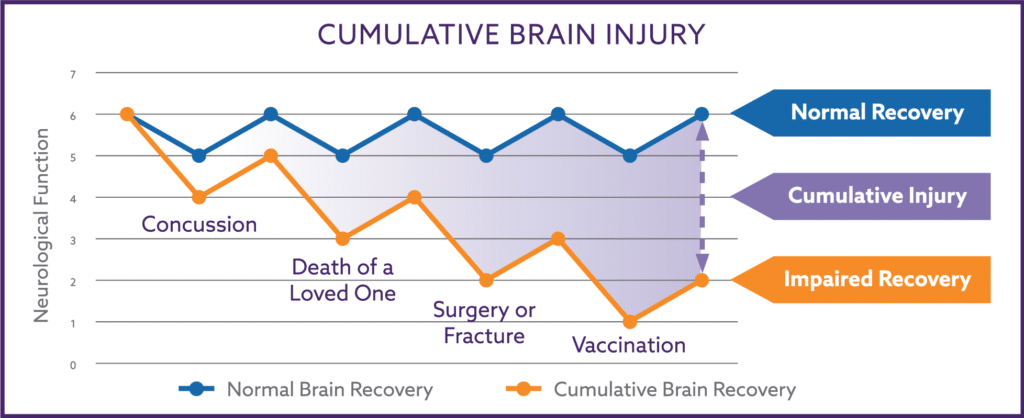
In adults, Dr. Nemechek says emotional trauma can contribute to cumulative brain injury. He gives examples including:
- Bankruptcy
- Divorce
- A near-fatal event (for example, a car sliding on ice and thinking you’re going to die)
- Being held at gunpoint
- Wartime and combat experiences
He emphasizes that the effects are not limited to “emotional” areas of the brain. While he highlights the hippocampus in the depression example, he also states that injuries from emotional trauma can involve multiple regions and can cause damage to the autonomic nervous system itself (which aligns with his broken heart syndrome discussion).
Why some people don’t recover as expected
Dr. Nemechek states that humans are designed to fully recover from these injuries in a few weeks to a couple of months at most. In his view, when someone does not recover within that window, it suggests an ongoing inflammatory process in the brain.
He describes that inflammatory process as a combination of:
- Gut bacterial overgrowth
- Deficiency of DHA omega-3
In his framework, these factors can prevent the brain from fully repairing after emotional trauma, allowing cumulative injury to “slowly” expand throughout the brain over time.
Emotional trauma in children: different triggers, similar vulnerability
Dr. Nemechek notes that children experience emotional traumas too, but he encourages adults to view them through a child’s eyes. He describes that when children are very young, parents function as a primal life source—alongside essentials like water and oxygen. Because of that, he suggests that separation-based experiences can be traumatic in a way adults may underestimate.
Examples he gives include:
- Parental divorce or separation
- The death of a family pet
- The death of a grandparent
- A young child feeling abandoned (for example, a parent being out of sight longer than expected)
He also highlights bullying as a particularly powerful driver of brain injury in the cases he sees—stating it can be “devastating” in adults and significant in children. He further cites severe forms of trauma such as child abuse and molestation as causes of “significant” brain damage.
Dr. Nemechek’s recovery framework (as described in this video)
Dr. Nemechek concludes that emotional traumas are “very, very real” and, in his words, can be as damaging as major physical head trauma. He then outlines elements of his approach to support recovery when it does not occur as expected, including addressing DHA omega-3 status and reducing the effects of vegetable oils in the food supply using olive oil. He also notes that for many people over about 35–40, he uses a vagus nerve stimulator to help achieve full recovery.
Medical disclaimer: This article summarizes statements and opinions presented by Dr. Patrick Nemechek in the referenced video and is for general education only. It is not medical advice and is not a substitute for individualized care from a licensed clinician. If you have persistent depression, trauma symptoms, or concerns about brain injury or autonomic dysfunction, seek evaluation from a qualified healthcare professional.