Uncategorized

Uncategorized

The Misdiagnosis of High Blood Pressure: When “Hypertension” Is Actually a Stress-Driven Pattern

In Dr. Patrick Nemechek’s clinical experience, a growing number of adults are being told they have “new” high blood pressure—sometimes alongside new findings like pre-diabetes—and they’re quickly started on medication. Then a frustrating pattern follows: the medication makes them feel unwell, and at the next visit the office blood pressure reads even higher, prompting additional […]

The Misdiagnosis of High Blood Pressure: When “Hypertension” Is Actually a Stress-Driven Pattern Read More »

When Progress Stalls on the Nemechek Protocol: Understanding Inulin Intolerance and “Inulin Failure”

In the Nemechek Protocol, one of the most common concerns parents raise is: “We’ve been doing the oils and inulin, but my child doesn’t seem to be getting better.” In this clinical review, Dr. Patrick Nemechek explains how he thinks through a lack of progress over months—especially when families focus on the wrong variables. In

When Progress Stalls on the Nemechek Protocol: Understanding Inulin Intolerance and “Inulin Failure” Read More »

Sudden hair loss: Dr. Nemechek’s clinical framework on inflammation, stress, and post‑COVID effects

Sudden hair loss can be alarming—especially when it seems to show up over a week or two, such as a noticeable increase in hair in a brush or shower drain. In this video, Dr. Patrick Nemechek focuses on sudden-onset shedding rather than long-term thinning patterns like male pattern baldness. He outlines a practical way to

Sudden hair loss: Dr. Nemechek’s clinical framework on inflammation, stress, and post‑COVID effects Read More »

Brain injury, blood pressure to the brain, and why nicotine or ADHD medications may feel helpful

In this clinical review, Dr. Patrick Nemechek discusses a framework for understanding why some people develop problems with focus, fidgeting, headaches, and nicotine use after a concussion or other brain injury. His central point is that the body must constantly regulate blood pressure upward to the head when we are upright, and that this regulation

Brain injury, blood pressure to the brain, and why nicotine or ADHD medications may feel helpful Read More »

Research update: how systemic inflammation can block brain recovery

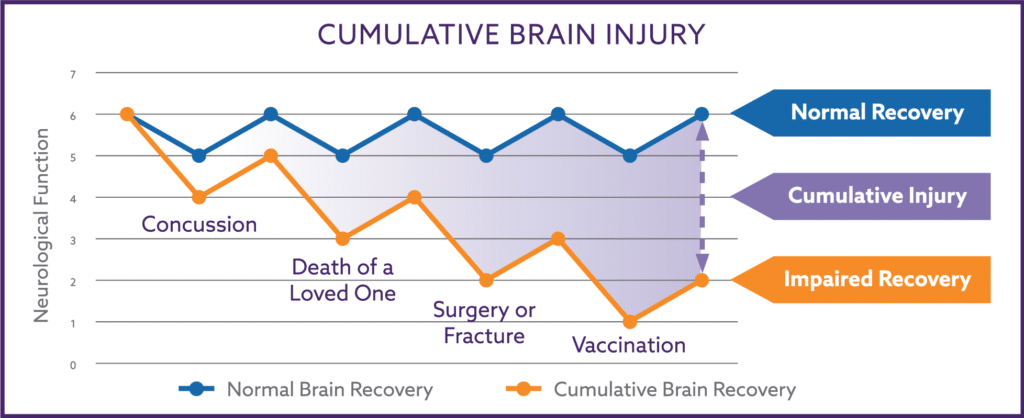
In this research update, Dr. Patrick Nemechek emphasizes a central clinical theme in his work: recovery from neurological injury is “all about inflammation.” In his framework, many people should recover from common non-bleeding brain insults—such as minor traumatic brain injury (concussion) and even “sub-concussive events”—within weeks to a couple of months if the body is

Research update: how systemic inflammation can block brain recovery Read More »

Managing chronic inflammatory signals after successive viral events: a Long COVID case update

Publication date: 2024-04-20 In this research update, Dr. Patrick Nemechek reviews a single Long COVID case to illustrate how he sequences different parts of his protocol when symptoms persist after one viral event—and then flare again after a subsequent infection. The goal, as he frames it, is to control chronic inflammatory signaling that appears to

Managing chronic inflammatory signals after successive viral events: a Long COVID case update Read More »

Why Dr. Nemechek emphasizes extra virgin olive oil: overnutrition, linoleic acid toxicity, and metabolic inflammation

In this talk, Dr. Patrick Nemechek focuses on a specific form of “overnutrition”—a concept he says is becoming more common in scientific and medical discussions—where nutrients in excess can create harm. His key point is that some substances can be safely excreted when intake is modest, but others can build up or drive damaging downstream

Why Dr. Nemechek emphasizes extra virgin olive oil: overnutrition, linoleic acid toxicity, and metabolic inflammation Read More »

Clinical observation: long COVID symptoms in kids and a framework for post-viral inflammation

Note: This article is a proposal based solely on the supplied video transcript and reflects Dr. Patrick Nemechek’s comments and clinical interpretations in that video. It is intended for human review and educational use only. In this video, Dr. Patrick Nemechek discusses “long COVID” in children—symptoms that persist after the acute infectious phase has resolved.

Clinical observation: long COVID symptoms in kids and a framework for post-viral inflammation Read More »

How long should a child stay on inulin on the Nemechek Protocol?

Parents sometimes reach a point on Dr. Patrick Nemechek’s protocol where their child has made “tons of recovery,” seems close to normal, and the natural next question is: Do they still need inulin? In a recent discussion, Dr. Nemechek addresses how he thinks about long-term management when a child is doing well on fish oil,

How long should a child stay on inulin on the Nemechek Protocol? Read More »

Why behavior can suddenly worsen during illnesses in children with autism (Dr. Nemechek’s clinical explanation)

Parents of children with autism sometimes see a sudden, dramatic worsening of behavior that seems to come “out of nowhere.” Dr. Patrick Nemechek describes this as a common and understandably frightening pattern—especially when a child who was doing relatively well suddenly becomes much more dysregulated. In the clinical framework he discusses, these episodes often align

Why behavior can suddenly worsen during illnesses in children with autism (Dr. Nemechek’s clinical explanation) Read More »

Cerebral hypoperfusion in autism: Dr. Nemechek’s clinical framework for brain low pressure symptoms

Dr. Patrick Nemechek discusses “brain blood pressure,” also called cerebral perfusion pressure, and why he believes low cerebral perfusion (“cerebral hypoperfusion”) can be a major driver of day-to-day symptoms in children with autism. In the video, he first uses a familiar example—post-concussion symptoms in otherwise neurotypical teens and adults—to describe how low brain blood pressure

Cerebral hypoperfusion in autism: Dr. Nemechek’s clinical framework for brain low pressure symptoms Read More »

What to Expect When Starting the Nemechek Protocol: the “Awakening” and Early Behavior Changes

When families consider starting the Nemechek Protocol, one of the most common fears Dr. Patrick Nemechek hears is that the beginning will be “sheer chaos.” In this video, he addresses that worry directly—based on his clinical experience—by outlining a set of early physiological and behavioral patterns he commonly sees, and why the most intense period

What to Expect When Starting the Nemechek Protocol: the “Awakening” and Early Behavior Changes Read More »

Minor Cognitive Impairment (MCI) and attention deficit states: Dr. Nemechek’s clinical framework

Minor cognitive impairment (MCI) is often described in a way that can alarm patients and families—especially when it’s loosely framed as “pre-Alzheimer’s.” In this clinical review, Dr. Patrick Nemechek challenges that label directly, emphasizing that the majority of people with MCI do not go on to develop Alzheimer’s disease. He also draws a practical distinction

Minor Cognitive Impairment (MCI) and attention deficit states: Dr. Nemechek’s clinical framework Read More »

Lightheadedness, Dizziness, Vertigo, and Disequilibrium: How Dr. Nemechek Defines the Difference

People often use the word “dizzy” to describe a wide range of uncomfortable sensations—feeling off-balance, unsteady, like the room is moving, or like they might faint. In this video, Dr. Patrick Nemechek explains that “dizzy” is common language, but medically it’s not very precise. To help patients communicate symptoms more clearly, he outlines a practical

Lightheadedness, Dizziness, Vertigo, and Disequilibrium: How Dr. Nemechek Defines the Difference Read More »

Metabolic therapy in cancer care: Dr. Nemechek’s overview of metformin and DCA

In this video, Dr. Patrick Nemechek shares an overview of how he thinks about supporting people undergoing standard cancer treatment. He emphasizes that he supports conventional oncology care—such as chemotherapy, radiation therapy, surgery, hormonal therapies, and immunotherapy (including checkpoint inhibitors)—and describes an additional strategy he refers to as metabolic therapy. In Dr. Nemechek’s framework, metabolic

Metabolic therapy in cancer care: Dr. Nemechek’s overview of metformin and DCA Read More »

The autonomic nervous system: what it does and what can damage it

In this video, Dr. Patrick Nemechek describes the autonomic nervous system as the body’s “automatic” nervous system—the part that runs critical functions you can’t consciously control. In his explanation, the autonomics are responsible for coordinating organ-level “machinery” such as digestion, blood pressure regulation to the brain, hormone fluctuations, and (as research is increasingly exploring) aspects

The autonomic nervous system: what it does and what can damage it Read More »

Research review: how Dr. Nemechek links the gut–immune–brain axis to common neurological disorders

In this research review, Dr. Patrick Nemechek discusses a recurring theme he says he sees across many chronic neurological and central nervous system (CNS) conditions: problems that may begin in the intestinal tract. He focuses on what the literature often calls the gut–brain axis (or, as he emphasizes, a broader gut–immune–brain axis) and how altered

Research review: how Dr. Nemechek links the gut–immune–brain axis to common neurological disorders Read More »

Long COVID, POTS, and Autonomic Nervous System Dysfunction

Long COVID, POTS, and Autonomic Nervous System Dysfunction For many people, recovering from the initial COVID infection is only the beginning. Weeks or months after the fever, respiratory symptoms, and other acute symptoms have resolved, a substantial number of patients develop new or persistent problems that are now collectively referred to as Long COVID. Among

Long COVID, POTS, and Autonomic Nervous System Dysfunction Read More »

POTS Is Real — and Understanding the Autonomic Nervous System Matters

“`html POTS Is Real — Understanding Autonomic Dysfunction and Recovery Postural Orthostatic Tachycardia Syndrome, or POTS, can be profoundly frustrating because patients may feel very ill while routine testing fails to explain why. Common symptoms include fatigue, headaches, lightheadedness, difficulty concentrating, exercise intolerance, anxiety-like sensations, and a rapid increase in heart rate when upright. These

POTS Is Real — and Understanding the Autonomic Nervous System Matters Read More »

Why Olive Oil is So Powerful at Reducing Inflammation

Dr. Nemechek discusses which component of olive oil is responsible for most of its anti-inflammatory properties. Spoiler alert: it’s not the level of phenols. See How Well the Protocol Works for Kids – https://youtu.be/FCvQx5YAeEU Autonomic Dysfunction Self Test – https://www.nemechekconsultativemedicine.com/quiz/ Appointments – Learn more about making an appointment to see Dr. Nemechek. One visit to

Why Olive Oil is So Powerful at Reducing Inflammation Read More »

How The Nemechek Protocol Works

Dr. Nemechek reviews the basic scientific premise of why his protocol helps with the recovery of the nervous system. See How Well the Protocol Works for Kids – https://youtu.be/FCvQx5YAeEU Autonomic Dysfunction Self Test – https://www.nemechekconsultativemedicine.com/quiz/ Appointments – Learn more about making an appointment to see Dr. Nemechek. One visit to Arizona and follow-up visits are

How The Nemechek Protocol Works Read More »

Reversal of POTS Using Both Rifaximin and Glutamine

Dr. Nemechek describes a case of POTS that required the use of both rifaximin and glutamine to eliminate the inflammation from a leaky gut. After this was achieved, the patient had a nearly complete recovery over the following few months. Autonomic Dysfunction Self Test – https://www.nemechekconsultativemedicine.com/quiz/ Appointments – Learn more about making an appointment to

Reversal of POTS Using Both Rifaximin and Glutamine Read More »

The Increasing Incidence of Brain Fog, Poor Cognition, and Impaired Memory

Dr. Nemechek reviews the growing incidence of disability due to reduced cognitive function, often referred to as brain fog. Learn More – info@autonomicmed.com or call 623-208-4226 Appointments – Learn more about making an appointment to see Dr. Nemechek. One visit to Arizona and follow-up visits are done via Skype. – NemechekAutonomicMedicine.com Supplements and Books –

The Increasing Incidence of Brain Fog, Poor Cognition, and Impaired Memory Read More »

SIBO and COVID Can Trigger 2 Different Forms of Leaky Gut

Dr. Nemechek discusses how inflammation can be triggered by 2 forms of leaky gut. One is from SIBO or bacterial overgrowth, and the other is from glutamine deficiency due to the hyperinflammation triggered by COVID. Interested in seeing Dr. Nemechek for help in recovering from autonomic dysfunction, COVID, or leaky gut? Contact us at info@autonomicmed.com.

SIBO and COVID Can Trigger 2 Different Forms of Leaky Gut Read More »

Dr. Nemechek is Granted U.S. Patent for Use of VNS Against COVID-19

Congratulations to Dr. Patrick M. Nemechek, D.O., for receiving U.S. Patent No. 11,123,560 granted on 9/21/2021 titled “Methods of Treating Covid-19 Induced Cytokine Storm” through the administration of supportive medical care through transcutaneous Vagus Nerve Stimulation (tVNS). A short video reviewing the results of Dr. Nemechek’s clinical trial of tVNS in hospitalized COVID-19 patients can

Dr. Nemechek is Granted U.S. Patent for Use of VNS Against COVID-19 Read More »

Do You Have Autonomic Dysfunction?