Why do some people recover from concussions and other brain “hits,” while others seem to stay stuck for years? In this video, Dr. Patrick Nemechek walks through a mechanism-focused explanation using an animal study framework and his clinical observations, emphasizing a proposed role for gut bacterial imbalance (SIBO) in changing how the brain’s immune cells behave after injury.
In Dr. Nemechek’s description, a healthy nervous system can take repeated “micro-damage” events—physical trauma (like a fall or car wreck), emotional/non-traumatic events (he uses the example of “broken heart syndrome”), or inflammatory insults (he mentions vaccine injury in the study context and chemotherapy as another example)—and still return to baseline neurological function over time.
But he contrasts that expected recovery pattern with what he says is happening more commonly now: people behave more like the “non-recovering” model, where the brain’s immune response no longer turns on and off in a restorative way.
Healthy recovery vs. a “stuck” inflammatory state: the model Dr. Nemechek describes
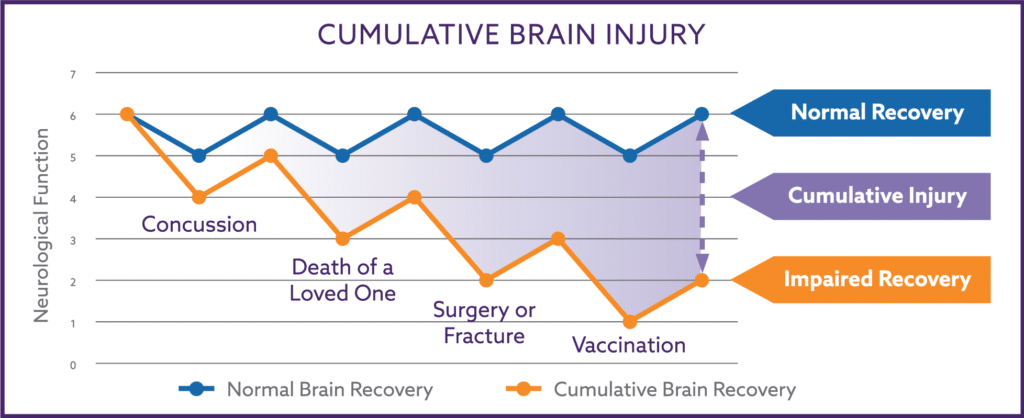
Dr. Nemechek explains the study’s central comparison using two sets of mice: a “healthy” group (depicted as white circles) and a group that had a brief episode of SIBO (depicted as black squares). Neurological function is tracked over time; when the curve drops, the mice show measurable problems such as headache, dizziness, or balance issues (as assessed by the study’s methods).
In the healthy mouse model, a concussion-like hit causes a decline in function. Then, the brain’s immune cells—microglia—activate, “fix the brain,” and function returns to baseline. Repeated hits follow the same pattern: decline, activation/repair, and return to normal. The key point in his narrative is that, by the end, the mouse is essentially the same neurologically as when it started.
Dr. Nemechek emphasizes that many real-life events can produce this kind of micro-damage—damage that could be seen under a microscope but may not appear on a standard CT or MRI—and that, in a properly functioning system, recovery should occur over a period of months.
How a brief SIBO episode is proposed to change microglia long-term
The “black square” mouse, in Dr. Nemechek’s telling, had SIBO (an imbalance of gut bacteria) for one day, three months earlier. Despite the brevity of the gut event, he says it appears to permanently change how microglia function in the brain. In his explanation, microglia that should live only a few days and then be replaced may instead fail to die (“they don’t die…they are immortal at this point,” as he states in the video).
More importantly for recovery, he describes these altered microglia as turning on differently. Rather than supporting repair, they may add to damage when activated, continuously releasing inflammatory signals he refers to as pro-inflammatory cytokines.
In the model he presents, the consequences show up when injuries are repeated:
- After a similar hit, the SIBO-exposed mouse does worse initially than the healthy mouse.
- Recovery after the first injury is incomplete.
- Because the brain is already weakened and microglia don’t “turn off,” a second impact has a much larger effect with little recovery.
- A third impact becomes catastrophic in the study’s trajectory.
Dr. Nemechek connects this pattern to what people often hear about repeated injuries in athletes, describing a downward slope rather than a return to baseline.
What autonomic testing can look like when recovery doesn’t happen
Dr. Nemechek also describes a clinical example using autonomic testing, focusing on the “stand portion” of the test. In the scenario he outlines, the person shows impairment in the sympathetic response, which he calls one of the most common findings after traumatic head injury.
In his clinical description, this pattern may correlate with problems such as difficulty maintaining blood pressure to the brain and associated symptoms—trouble focusing and concentrating, anxiety, feeling fidgety, cravings for salt or sugar, and even nicotine addiction. The example he gives is notable because the injury occurred 30 years earlier, and yet the abnormal pattern remained—whereas he says a healthy recovery would typically normalize in “2 or 3 months.”
Within his framework, the reason the person stayed “stuck” was the same theme as the mouse model: microglia that wouldn’t shut off and continued to drive inflammatory output rather than completing a repair cycle.
Dr. Nemechek’s clinical framework for supporting recovery: DHA and vagal nerve stimulation
Dr. Nemechek states that, in his practice, using high-dose DHA and vagal nerve stimulation helps “suppress that inflammation” and support repair mechanisms, allowing people to recover toward normal on autonomic testing and symptom-wise.
He also shares a recurring clinical pattern: some patients improve but then relapse when they stop vagal nerve stimulation or cut back on DHA. In his interpretation, when that support is removed, the abnormal microglia “fire up,” inflammation returns, and function deteriorates again.
He references an additional mouse trajectory (depicted as triangles): a mouse that had SIBO but does not receive concussions. In that model, he says the abnormal microglia alone can still add to damage over time, even without subsequent concussion events.
How long does it take to “flip” microglia back to normal?
Dr. Nemechek is explicit that the long-term timeline is unknown. He notes there is currently no way to know whether it takes a few years, five years, or ten years to fully reverse the underlying microglial issue he describes. His stated “good news,” as presented in the video, is that people with this persistent pattern can still be helped to recover—though ongoing support may be needed.
Links Dr. Nemechek draws to depression and PTSD recovery
In the video’s closing, Dr. Nemechek adds that the same phenomenon he is describing—microglia that don’t reset and thereby prevent restoration—also prevents some people from recovering after episodes that lead to depression or post-traumatic stress disorder. In his framework, addressing these brain immune cells with DHA and vagal nerve stimulation can allow function to come “back up to normal.”
Educational medical disclaimer: This article summarizes concepts from a video by Dr. Patrick Nemechek and is for general education only. It is not medical advice and is not a substitute for diagnosis or treatment by a licensed clinician. If you have persistent symptoms after concussion, autonomic symptoms, depression/PTSD symptoms, or concerns about SIBO, seek individualized medical care.