In this science review, Dr. Patrick Nemechek (inventor of The Nemechek Protocol™ for autonomic dysfunction, autism, and developmental disorders) describes inflammation through the lens of autonomic nervous system damage. His central message is that the brain’s autonomic control—especially the parasympathetic signal traveling through the vagus nerve—functions as a critical “brake” on inflammatory activity.
He frames dysautonomia (autonomic dysfunction) as a problem that can impair that braking system. When the parasympathetic/vagal anti-inflammatory control is weakened, inflammation may become more pervasive and harder to shut off appropriately. In his clinical framework, protecting and restoring brain/autonomic health is foundational: “Fix the brain—fix the body.”
Below is a structured summary of the concepts Dr. Nemechek presents, using his terminology and perspective.
The cholinergic anti-inflammatory pathway (CAP) and the “vagal inflammatory reflex”
Dr. Nemechek points to what’s often called the cholinergic anti-inflammatory pathway (CAP), also described as the vagal inflammatory reflex. He explains it as the mechanism by which the brain regulates immune/inflammatory activity through the autonomic nervous system.
He reviews a basic autonomic model with two major branches/signals coming out of the brain:
- Sympathetic
- Parasympathetic (with the signal traveling down the vagus nerve)
In his explanation, the parasympathetic/vagal signal serves as a brake on white blood cells—a way for the brain to keep inflammatory “soldiers” from activating unnecessarily. This braking function is not meant to eliminate inflammation entirely; rather, it helps keep inflammatory activity proportionate and time-limited.
How inflammation is supposed to turn on—and then turn off
Dr. Nemechek describes inflammation as a controlled, adaptive process when the system is working properly. Using examples like a sprained ankle or an infection, he explains that the brain can detect injury or threat and allow inflammatory activity to increase. In his model, this corresponds to the parasympathetic “brake” being reduced so white blood cells can mobilize in the bloodstream and reach the affected area.
Then, once repair is sufficiently complete, he describes the brain as reapplying the brake—signaling inflammatory activity to stand down.
Where omega-3 and omega-6 fats fit in (as he describes them)
Dr. Nemechek uses a practical analogy for omega fatty acids. He suggests thinking of omega-6 fats as “wrenches” used during the repair process, and omega-3 fats as part of what helps the body turn the inflammatory process off after the brain signals that the job is done. In his framing, the autonomic signal and fatty-acid balance are both relevant to whether inflammation resolves appropriately.
What happens when autonomic damage weakens the parasympathetic “brake”
Dr. Nemechek then addresses what he sees when autonomic damage does not resolve and the parasympathetic system is affected. In that scenario, he says the body can develop more inflammation throughout the body because the “master controlling mechanism” is no longer functioning normally.
He lists a range of inflammation-associated problems he connects to this breakdown, including increased joint pain, muscle pain, and other types of inflammatory pain. He also states that inflammatory processes contribute to blood vessel damage that precedes events like stroke and heart attack.
In addition, he characterizes chronic depression and PTSD as chronic inflammatory disorders in which an emotional trigger may occur but recovery is impaired because inflammation remains chronically active.
Autoimmune disorders: his interpretation of the sequence
Dr. Nemechek specifically discusses autoimmune disorders and offers an interpretation of emerging evidence in the research community as he understands it. He states that for rheumatoid arthritis and Crohn’s disease in particular, you “have to have autonomic damage” and that the parasympathetic inflammatory reflex must break down before those conditions can develop.
He adds that, based on conversations around research in the field, there is an inclination that this may hold true for most autoimmune disorders—meaning autonomic/brain injury comes first, then autoimmune disease follows once inflammatory control becomes highly dysregulated.
Sources of brain injury he lists—and why recovery may fail
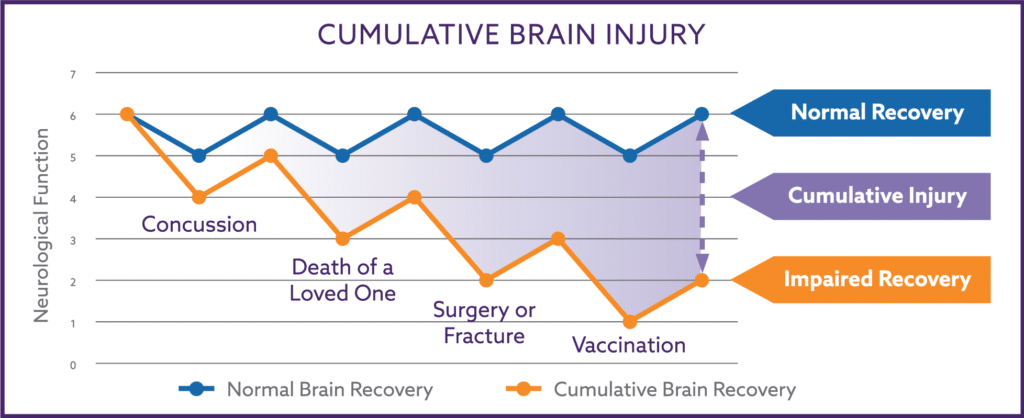
In his framework, if a person already has an autoimmune disorder, that may imply prior brain injury that did not fully resolve, with ongoing inflammatory issues in the brain. He lists several categories of insults that, in his view, can injure the brain and initiate this process, including:
- Physical injury
- Emotional trauma
- “Inflammatory traumas” such as vaccines, surgeries, or fractures (as he describes them)
He notes that when “things work right,” the brain can fully recover in about two weeks. However, he states that recovery may fail when there are underlying issues discussed in The Nemechek Protocol™, including excessive omega-6, inflammation related to bacterial overgrowth from the gut, and exposures such as tobacco smoke or other environmental factors. In his model, these factors can leave residual brain/autonomic damage that accumulates over time, eventually impairing parasympathetic control of inflammation.
Clinical takeaway: brain health and autonomic function as a foundation
Dr. Nemechek’s closing emphasis is that autonomic nervous system integrity is central to whole-body health because it governs inflammatory regulation. In his words, maintaining and restoring a healthy autonomic nervous system supports the body’s ability to control inflammation system-wide.
Want to Learn More About POTS and Autonomic Dysfunction?
Download Dr. Nemechek’s free POTS/PANS/PANDAS eBook for a deeper explanation of autonomic dysfunction, inflammation, and recovery.
Medical disclaimer: This article summarizes concepts discussed by Dr. Patrick Nemechek in a single educational video and reflects his clinical framework and interpretations. It is not medical advice and is not a substitute for individualized evaluation, diagnosis, or treatment from a licensed clinician.