Want to Learn More About POTS and Autonomic Dysfunction?
Download Dr. Nemechek’s free POTS/PANS/PANDAS eBook for a deeper explanation of autonomic dysfunction, inflammation, and recovery.
Medical disclaimer: This article summarizes clinical observations and a framework discussed by Dr. Patrick Nemechek in a video. It is for education only and is not medical advice, diagnosis, or a substitute for care from your own clinician. Do not attempt testing or treatment changes without medical guidance.
Postural orthostatic tachycardia syndrome (POTS) is commonly described as a condition where, when you are upright, your heart races. In this discussion, Dr. Patrick Nemechek frames POTS as a problem of the autonomic nervous system—specifically, an injury that disrupts how the body regulates blood pressure and blood flow to the brain.
He also shares two cases where POTS symptoms were complicated by COVID (“Co” in the transcript), and how the clinical course shifted when COVID-related intestinal barrier problems (“leaky gut”) were addressed as part of his protocol aimed at lowering chronic inflammation.
POTS as an autonomic nervous system injury
Dr. Nemechek emphasizes that many autonomic nervous system injuries make it difficult to regulate blood pressure in the head. When blood pressure and oxygen delivery to the brain are low, people can feel very unwell and develop a wide range of symptoms.
He contrasts two related patterns:
Neurogenic orthostatic hypotension
In this pattern, autonomic damage shows up predominantly as low blood pressure with symptoms such as lightheadedness, feeling like you might pass out (or actually passing out), difficulty focusing, and significant fatigue.
POTS
In POTS, Dr. Nemechek describes the key difference as how the heart responds. Heart rate acts as a pump to help drive blood pressure to the brain. Many people with low blood pressure have a modest heart rate rise (for example, to 100–110). With POTS, however, standing up (with gravity working against circulation) triggers a disproportionate jump—often 30, 40, or 50 beats—accompanied by sensations that the heart is “taking off,” and often a lot of anxiety. In his framework, both patterns reflect a blood-pressure-to-the-brain regulation problem; POTS is a distinct expression of that same injury.
A practical way POTS is identified (with safety cautions)
Dr. Nemechek describes a simple at-home version of a tilt test, while stressing safety. The process he outlines is: lie down for about 10 minutes, check blood pressure and heart rate, then stand for 10 minutes and re-check. He warns not to do this alone, because people can pass out even if they think they won’t.
In his description, a heart rate increase of about 30 beats per minute (or a heart rate over 120) supports the POTS pattern—especially when paired with symptoms such as fatigue, headaches, anxiety, poor focus, dizziness, and lightheadedness. He notes this type of self-check tends to come up when routine blood tests have been normal and clinicians are still trying to determine what’s going on.
Why recovery may stall: chronic inflammation and gut-related drivers
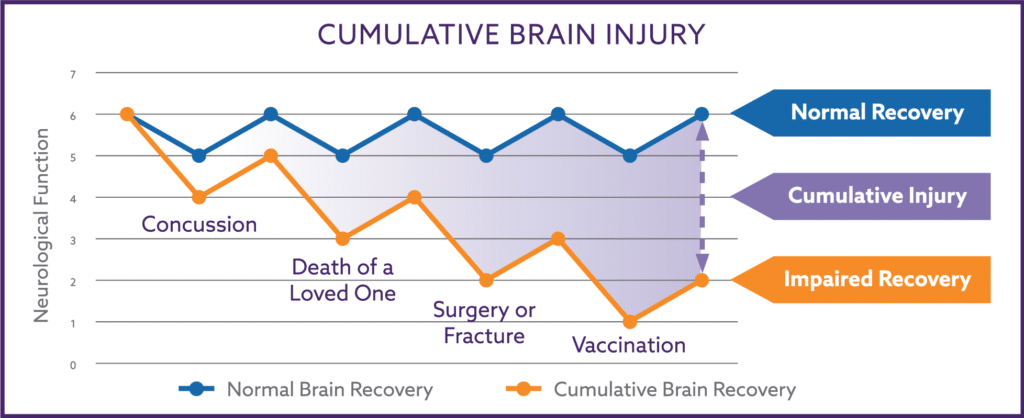
Dr. Nemechek connects changes in recovery patterns over the last ~20 years (notably in concussion recovery) to chronic inflammation. He states that the basis of the Nemechek Protocol is to reduce inflammation because, in his view, the brain is fully capable of recovering if there is not “excess inflammation.”
In the video, he describes core components of his protocol as:
- Balancing the intestinal tract bacteria
- Supplementing with fish oil with olive oil
- Using a vagus nerve stimulator (VNS)
A central gut concept he uses is SIBO: bacteria that are normal in the colon living in the wrong place (the small intestine), which he associates with “leaky gut” and increased inflammation. He describes using rifaximin to stabilize this bacterial balance and, in turn, reduce inflammation that can interfere with nervous system recovery.
He also emphasizes an additional COVID-related pattern: a different type of intestinal barrier injury where cells “die” and create a larger leak. In his clinical approach, glutamine is used to address this barrier problem.
Case 1: Marta — POTS after COVID and the “missing piece”
Marta, a young woman who had been healthy, developed COVID about a year and a half prior to seeing Dr. Nemechek. He states that COVID can cause a brain injury “from the inflammation.” Her respiratory symptoms resolved quickly, but she deteriorated over the next six months and was diagnosed with POTS by a cardiologist (lightheadedness, racing heart, fatigue, brain fog, chest pain).
She started his protocol in December 2023: rifaximin (described as continuous twice daily), fish oil with olive oil, and vagus nerve stimulation. Within a few weeks she began to improve, but by May—despite being clearly better—she was not where he expected clinically, suggesting something was still holding back recovery.
Based on emerging research at the time (as he describes it), he suspected a COVID-triggered “different kind of leaky gut” and added glutamine. He specifies the dose used in her case as 15 grams twice daily (described as a level tablespoon of powdered glutamine). He reports that within a few months she felt completely normal and described the glutamine addition as a “game changer” and the missing piece.
For maintenance, he describes continuing fish oil and olive oil daily, stopping vagus nerve stimulation once it was no longer needed, and using a short course of rifaximin if symptoms begin creeping back over a week or two (for example, mild racing heart or intestinal symptoms). He notes relapses can occur—timing varies widely—and his approach is to teach patients to recognize their personal symptom pattern (“the fingerprint”).
Case 2: Jenna — concussion-related POTS, improvement, then COVID setback
Jenna, 40, had a severe concussion in 2019 and developed headaches, fatigue, dizziness, rapid heart rate, chest pain, anxiety, and severe premenstrual syndrome. Dr. Nemechek states that premenstrual syndrome is, “believe it or not,” a low blood pressure problem in this context. After trying various symptom-management approaches, she came to his practice.
Her protocol included cyclic rifaximin (he specifies 550 mg twice daily for 10 days each month), fish oil with olive oil, and vagus nerve stimulation (Vitality SmartCable). He reports she began improving within weeks and continued steady improvement—until she got COVID. He describes COVID as “bad,” immediately worsening her nervous system symptoms and leading to further deterioration after the acute respiratory phase.
Presuming COVID had triggered the barrier-leak pattern, he added glutamine. He reports that within a few months she felt “great,” and that in his experience patients are usually “totally normal” within about six months. Her ongoing maintenance plan mirrored the first case: fish oil and olive oil, VNS, and occasional 10-day rifaximin courses if symptoms start returning.
Key takeaway from Dr. Nemechek’s framework
Dr. Nemechek’s central message is that many people with POTS can recover. In his view, the brain has robust repair capacity (he references stem cells, microglia, and neurotrophins) but is hindered by chronic inflammation. In the cases he shared, addressing inflammation drivers—particularly gut-related contributors and, in post-COVID cases, an additional intestinal barrier injury treated with glutamine—was associated with improved autonomic stability and symptom resolution.