In Dr. Patrick Nemechek’s clinical experience, a growing number of adults are being told they have “new” high blood pressure—sometimes alongside new findings like pre-diabetes—and they’re quickly started on medication. Then a frustrating pattern follows: the medication makes them feel unwell, and at the next visit the office blood pressure reads even higher, prompting additional prescriptions.
In this video, Dr. Nemechek argues that one common problem is misclassification: intermittent or situational elevations in blood pressure are being labeled as chronic hypertension without enough verification. He also describes a physiological framework in which autonomic nervous system injury and chronic inflammation can contribute to these patterns.
Educational medical disclaimer: This article summarizes concepts discussed by Dr. Nemechek in a YouTube video and is for education only. It is not medical advice and is not a substitute for individualized diagnosis or treatment from your clinician. Do not start, stop, or change prescribed blood pressure medication without medical guidance.
Hypertension vs. intermittent elevation: what should be confirmed first
Dr. Nemechek emphasizes a practical starting point: if you’ve been newly diagnosed with high blood pressure, you should first confirm whether you truly have persistent, chronic elevated blood pressure (hypertension). In his words, the disorder is not an intermittent elevation—it is high blood pressure “24 hours a day whether you’re awake or asleep.”
In other words, a single office reading (for example, 150–160 systolic) should not automatically be assumed to reflect a person’s usual blood pressure at home, or their blood pressure during sleep.
“White coat hypertension” and why office readings can be misleading
Dr. Nemechek points to “white coat hypertension” as a common situation, and he describes it as an injury to the autonomic nervous system. In his framework, office visits can amplify stress and discomfort (waiting, the tension of being assessed), and that stress can worsen the blood-pressure pattern being measured—leading to a diagnosis of high blood pressure when the person’s day-to-day readings don’t match.
He also critiques what he sees as a “sloppy” clinical workflow in which some patients are prescribed blood pressure medications after a single elevated visit, rather than being asked to verify readings at home first.
How Dr. Nemechek recommends checking blood pressure at home
To help clarify whether blood pressure is persistently elevated, Dr. Nemechek recommends a simple home check:
- Use an automated upper-arm cuff (not wrist or finger cuffs, which he says are not very accurate).
- Check pulse and blood pressure twice in the morning, back-to-back, and write both down.
- Repeat this for three to four days to see where your numbers truly sit (he notes they may bounce around a bit).
He adds a clinical clue he often sees: people who feel unwell on blood pressure medications may find their morning pressures are low at home—suggesting that their at-home pattern does not match the office-based numbers that drove the diagnosis.
Dr. Nemechek’s framework: autonomic injury, low brain pressure, and compensatory arm readings
In the video, Dr. Nemechek explains his view of how the autonomic nervous system participates in blood pressure regulation, and how it can respond to injury. He states that the autonomic nervous system is sensitive to injury and that a common result is low blood pressure in the brain.
In his description, when the brain experiences low pressure (and thus inadequate oxygen delivery), it “panics” and triggers compensatory responses—through what he describes as chemical and neurological reflexes—to boost blood flow to the head. He lists several possible signals or behaviors the brain may drive in this state, including feeling fidgety, craving nicotine, craving salt or sugar, and wanting to lie down.
Importantly, he describes a scenario where low pressure happens first after the injury, and then the body increases pressure in the arm as a compensatory strategy—creating an office reading that looks like hypertension even though the underlying issue (as he frames it) began with low brain perfusion.
What counts as “injury” in this discussion (not just physical trauma)
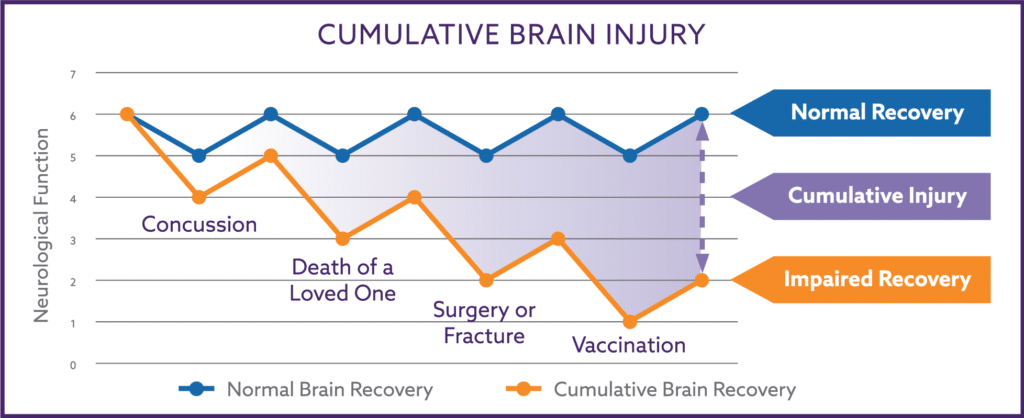
Dr. Nemechek clarifies that when he talks about “injury,” he is not only referring to obvious physical trauma. He gives multiple examples:
- Concussions and subconcussive injuries (he cites a soccer ball impact as an example).
- Emotional trauma and severe stressors (for example: a spouse dying, losing a house, being fired, financial panic, betrayal by a close friend).
- Inflammation as a driver of brain injury.
COVID, long COVID, and inflammation in Dr. Nemechek’s interpretation
A major theme of the video is that Dr. Nemechek is seeing COVID-related patterns frequently in his adult patients. He states that COVID can cause what he calls a “big inflammatory concussion,” and he describes a common scenario: a person gets COVID, sustains brain injury with low pressure, feels tired or “off,” then has a medical visit where the arm blood pressure is elevated and they are labeled hypertensive.
He also states that “long COVID happens in one-third of all people who are infected no matter how mild your symptoms,” that it can last one to three years or more, and that it is associated with “lots of inflammation.” In his framework, that inflammation interferes with recovery from the injury.
Inflammation as the shared backdrop for multiple new diagnoses
Dr. Nemechek repeatedly emphasizes chronic inflammation as a “big deal” for health, and he links it (in his interpretation) to why the nervous system may not recover on its own. He also describes a cluster of inflammatory-associated issues that may appear together in the same time frame as blood pressure concerns—mentioning pre-diabetes as an “inflammatory problem,” and stating that cancers can be activated by inflammation (he specifically mentions skin cancers being activated).
Within the boundaries of his discussion, his take-home point is that these conditions may not “disease out of thin air,” but can be triggered by inflammation—and he calls out COVID as something that is “walloping people right now.”
His practical priorities: verify pressure patterns, then address inflammation
Dr. Nemechek’s action steps in the video are straightforward:
- Double-check your pressures at home to determine whether you truly have persistent hypertension or a situational/variable pattern.
- Address inflammation, which he frames as central to recovery of the brain and autonomic nervous system.
He references “our protocol” as focusing on fish oil, olive oil, and balancing the gut with ReFlaM or inulin in cases of bacterial overgrowth. He also suggests that, given how common this is becoming in adults, 6 to 8 weeks of glutamine twice a day can help “fix the inflammatory damage in the gut” and “shut that off,” as he describes it.
In Dr. Nemechek’s interpretation, if inflammation is lowered sufficiently, the brain can recover, the blood pressure system can return to normal, and pre-diabetes “can go away.” He closes by emphasizing that, in his view, this is not something to wait out—“it’s not going to fix itself and it’s just getting worse.”