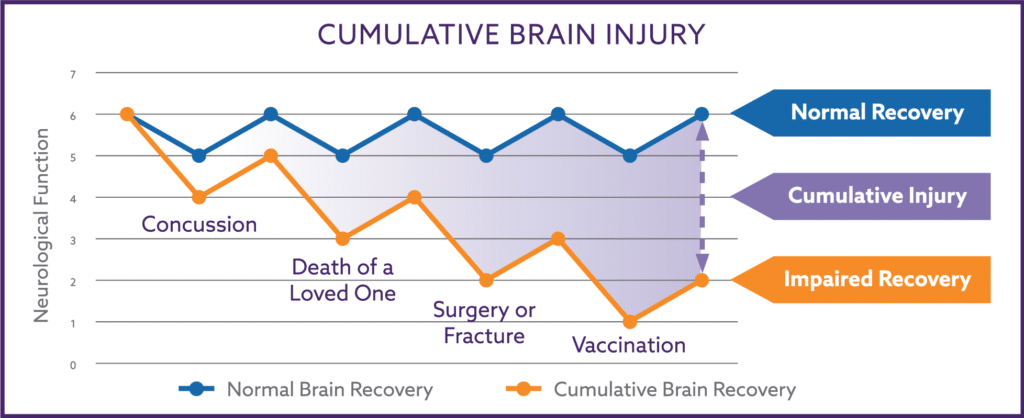
Minor cognitive impairment (MCI) is often described in a way that can alarm patients and families—especially when it’s loosely framed as “pre-Alzheimer’s.” In this clinical review, Dr. Patrick Nemechek challenges that label directly, emphasizing that the majority of people with MCI do not go on to develop Alzheimer’s disease.
He also draws a practical distinction between MCI and dementia. In his description, people with MCI are typically aware of their forgetfulness (and are often distressed by it), whereas people with Alzheimer’s-type dementia may not recognize that they are forgetting and may repeatedly tell the same story without awareness.
From there, Dr. Nemechek explains a framework he has used for decades: evaluating brain recovery through the lens of autonomic nervous system function—particularly how well the body maintains adequate blood pressure and oxygen delivery to the brain.
How Dr. Nemechek defines MCI vs. dementia
In the video, Dr. Nemechek characterizes MCI as a pattern of forgetfulness that the person can identify in real time—misplacing keys, struggling to recall a familiar name, or noticing lapses that feel unusual compared with prior functioning. He contrasts this with dementia (including Alzheimer’s disease), where the person may not know they are forgetting and may be unaware that they are repeating themselves.
This distinction matters because it changes the conversation from fear (“this must be Alzheimer’s”) to a more specific clinical picture that may have different contributing factors and different opportunities for improvement.
His clinical interpretation: a shared feature with attention deficit states
Dr. Nemechek proposes that a hallmark feature of MCI, in his clinical interpretation, is poor blood pressure in the brain. He explains the idea in functional terms: red blood cells carry oxygen, but if the pressure that helps deliver oxygen into the brain is not adequate, neurons may not receive oxygen as effectively. He notes that neurons have very little “spare” oxygen, so even modest changes in delivery can affect sharpness and function.
He then draws a parallel to attention deficit disorder and attention deficit hyperactivity disorder (ADD/ADHD). In his description, those attention deficit states also share autonomic features: the nervous system cannot create proper pressure in the brain, and oxygen delivery into neurons is impaired.
In that context, he explains why stimulant medications (such as those commonly used for attention deficit states) can help some patients: within his framework, stimulating the nervous system increases pressure in the brain, improves oxygen flow into neurons, and cognitive performance improves.
Blood pressure readings in the arm may be misleading (in his framework)
Another key point Dr. Nemechek raises is that low blood pressure in the brain may be accompanied by a compensatory rise in blood pressure measured in the arm. In his explanation, the body may “squeeze down” in the periphery to help push blood toward the head to normalize cerebral pressure. That can create a situation where an in-office arm reading appears elevated, even though the underlying issue he is focusing on is low pressure in the brain.
He cautions that simply treating an office reading—without understanding the broader pattern—may worsen cognitive symptoms in some people, particularly if blood pressure medications lower systemic pressure further.
How he suggests reviewing blood pressure patterns
For someone with MCI, Dr. Nemechek describes a home-measurement approach: checking blood pressure and pulse twice a day for several days (he mentions three to five days) to see a more representative trend. He also notes the importance of taking readings on days when you feel well, and not relying on a single reading taken when you feel unwell (for example, during a headache), because that can be misleading.
If someone is on blood pressure medications: a cautious, clinician-supervised discussion
In the video, Dr. Nemechek describes a common clinical scenario: a person with MCI is taking blood pressure medications and later discovers that their morning readings may actually be low (for example, around 105 systolic). In his clinical experience, this can be an opportunity to reassess whether all current medications are necessary.
He emphasizes doing this in concert with a primary care provider. He also provides examples of the kinds of decisions that may come up clinically: if someone needs a medication for a specific cardiac reason (he gives atrial fibrillation and rate control with metoprolol as an example), that medication may not be the one to adjust first. Instead, he suggests discussing whether other agents (he mentions examples such as lisinopril, amlodipine, or especially a “water pill”) could potentially be reduced—such as cutting a dose in half—then rechecking blood pressure over several additional days to see how the numbers respond.
In his framework, some patients may find their readings do not change much when certain medications are reduced, and they may end up needing fewer blood pressure-lowering drugs while maintaining acceptable morning blood pressure. He adds that, in his clinical observation, this can be associated with improved cognitive function when pressure in the brain becomes closer to normal.
His recovery-oriented protocol overview for MCI
Dr. Nemechek states that if someone has MCI and is not on blood pressure medications, “the good news” in his view is that the brain can still repair itself. He then briefly outlines the components of the protocol he uses in his practice, describing it as designed to support recovery by lowering inflammation and supporting brain function. The elements he names include:
- High DHA fish oil
- Olive oil
- Balancing gut bacteria
- At this age, using a vagus nerve stimulator
He describes a typical clinical timeframe in his practice: when he is managing patients, he commonly sees substantial improvement over “six to eight months,” with some patients reporting that symptoms are greatly improved or resolved.
Practical takeaways from the video
- MCI is described here as aware forgetfulness, distinct from dementia where the person may not recognize their memory loss.
- Dr. Nemechek’s framework links MCI and attention deficit states through autonomic features and low blood pressure in the brain.
- Arm blood pressure readings may reflect compensation; patterns over days may be more informative than a single office reading.
- Any medication changes should be coordinated with the patient’s primary care clinician, especially when cardiovascular conditions are present.
Educational medical disclaimer: This article summarizes a clinical discussion by Dr. Patrick Nemechek and is for education only. It is not medical advice and is not a substitute for individualized evaluation, diagnosis, or treatment from your licensed healthcare professional. Do not start, stop, or change prescription medications without guidance from your prescribing clinician.