Educational medical disclaimer: This article summarizes a clinical discussion by Dr. Patrick Nemechek and is for general education only. It is not medical advice. Vaccination decisions and timing should be made with your child’s clinician, taking into account individual history, risks, and local guidance.
In clinical visits, Dr. Patrick Nemechek says he commonly hears a practical question from families: if they are choosing to vaccinate, when is it safest to vaccinate a child who is also working through neurological symptoms—and should anything about the Nemechek Protocol be paused or modified around vaccination?
In the video, Dr. Nemechek frames his answer using an experimental model discussed in an early, well-known paper by Cole Cunningham on microglia, neurodegeneration, and the role of systemic inflammation. He uses that model to explain why the same immune stimulus might be followed by recovery in one situation and incomplete recovery in another—then translates that concept into his practical timing recommendations for families using his protocol.
Dr. Nemechek’s framework: a “healthy brain” repairs after a short inflammatory hit
In the video’s first scenario, Dr. Nemechek describes an individual who has remained balanced in intestinal bacteria—specifically, someone who has never had SIBO (small intestinal bacterial overgrowth), “leaky gut,” or ongoing systemic inflammation. In that setting, he describes the experimental model as follows:
- A “normal” (white) mouse receives a systemic inflammatory stimulus (in the study, an immune-stimulating product that he describes as similar to a vaccine stimulus).
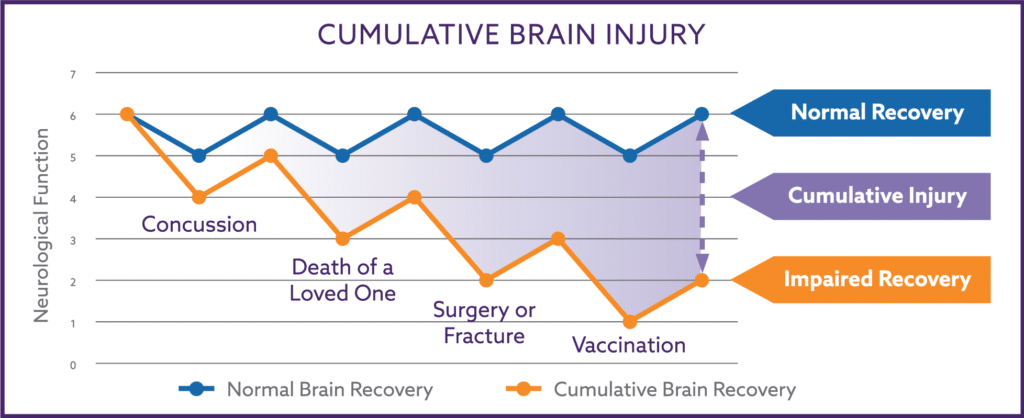
- After that stimulus, the mouse shows a temporary dip in a measured function score, including balance, swimming, and remembering a food maze.
- Microscopically, the mouse’s brain shows a small injury associated with that surge of inflammation.
- Importantly, the function score returns to baseline over the following weeks, and the mouse repeats this pattern with subsequent immune-stimulating events: a dip, then recovery.
Dr. Nemechek’s clinical interpretation is that this is what neurological resilience should look like when there is no active systemic inflammatory state. He characterizes the potential effect as minor and self-limited—comparing it, in scope, to a very mild concussion—and emphasizes the brain’s ability to repair within a short time when conditions are favorable.
How SIBO and LPS change the equation in this model
The second scenario introduces SIBO: bacteria that typically live in the colon are present and overgrowing in the small intestine. Dr. Nemechek describes this as a state where bacterial byproducts can provoke inflammation, and he highlights a specific molecule: lipopolysaccharide (LPS).
In his explanation, LPS is a normal molecule on the outside of certain bacteria (gram-negative rods). When those bacteria replicate, LPS is released—he uses an analogy of “sawdust” produced during woodworking. In the framework he describes, when the gut barrier is compromised, LPS can leak into the bloodstream, travel through the body, reach the brain, and alter immune cells in the brain.
He then describes what Cunningham’s model did next: the researchers introduced LPS and later applied the same immune-stimulating (vaccine-like) inflammatory stimulus. In that “black mouse” condition, the exact same stimulus is associated with:
- More severe injury than in the normal condition
- Incomplete recovery after the stimulus
- Additive worsening with repeated inflammatory events
Dr. Nemechek explains this in terms of microglia—white blood cells in the brain—becoming “M1 primed microglia,” which he defines in the video as a persistently inflammatory state. He also shares his belief (and notes that others share it) that autism involves this process and that “they all have this,” presenting this as his interpretive framework rather than a universal consensus claim.
What the protocol is intended to change, according to Dr. Nemechek
Dr. Nemechek states that the protocol was designed specifically to reverse this vulnerable, inflammation-amplifying state—by stopping or reducing LPS-related signaling and calming the brain’s inflammatory immune cells. In his description, components he emphasizes include:
- Olive oil
- DHA (omega-3) in fish oil
- Vagus nerve stimulation (which he says may be needed sometimes for children and “often” in adults)
He also notes, in passing, that “there is some data” that olive oil can contribute to calming these inflammatory cells, and he presents DHA as part of the approach to shifting microglia away from an inflammatory state. In the model language he uses, the goal is to help someone who is reacting like the “black mouse” begin reacting more like the “white mouse”—so that after an inflammatory hit there is repair rather than progressive worsening.
Practical guidance in the video: when Dr. Nemechek considers vaccination safer during the protocol
Dr. Nemechek’s key practical recommendation is a timing principle: do not vaccinate until you are seeing neurological improvements. In his framework, visible neurological improvement suggests the protocol has been sufficient to shift the child toward a more resilient, repair-capable state.
He explains the reason this way: if a vaccine (or vaccine-like immune stimulation) produces a short-lived inflammatory “concussion,” a resilient brain should repair it within days to a week. He shares that, in his conversations with parents in this situation, they sometimes report the child seemed “off for a couple days” and then returned to baseline.
By contrast, if a child is not improving, Dr. Nemechek interprets that as a sign that inflammatory control in the central nervous system has not been adequately established yet. In that case, he cautions that vaccination could potentially worsen the condition and make recovery harder at that time (within the interpretive model he is presenting).
How long to wait?
Dr. Nemechek describes a prudent waiting window of 2, 4, or 6 months on the protocol—until the family can clearly observe that the child “is improving now”—and then proceeding with vaccination if they wish to do so.
Do you stop or change the protocol around vaccination?
In the video, he says there is no need to stop or change the protocol while vaccinating.
Takeaway: resilience first, then immune stimulation
Within Dr. Nemechek’s clinical interpretation, the central issue is not simply the vaccine itself, but the state of neurological and systemic inflammation at the time an immune stimulus occurs. Using the Cunningham mouse model as a conceptual guide, he describes two broad patterns: a temporary dip followed by repair versus additive injury with incomplete recovery when LPS-driven inflammation has primed microglia.
His practical bottom line for families who plan to vaccinate is to wait until neurological improvement is clearly underway on the protocol—indicating, in his words, a shift from “black mouse” vulnerability toward “white mouse” resilience—then proceed without pausing or modifying the protocol.