In this video, Dr. Patrick Nemechek describes the autonomic nervous system as the body’s “automatic” nervous system—the part that runs critical functions you can’t consciously control.
In his explanation, the autonomics are responsible for coordinating organ-level “machinery” such as digestion, blood pressure regulation to the brain, hormone fluctuations, and (as research is increasingly exploring) aspects of immune regulation—especially the control of inflammation throughout the body.
Below is a polished summary of his framework for what the autonomic nervous system does and the major categories of events he says can damage it.
What the autonomic nervous system does (the body’s “AUTOMATICS”)
Dr. Nemechek’s simplest way to understand the autonomic nervous system is to think of it as “automatic.” You can decide to move your hand, but you can’t consciously decide how fast your stomach empties or exactly how your blood pressure to your brain is regulated.
He describes the autonomic nervous system as having two branches:
- Sympathetic
- Parasympathetic
He notes that older labels for these branches are “fight-or-flight” and “rest-and-digest,” though he adds that those terms are not commonly used in the way he is presenting the concept here. In his description, these two branches work like a coordinated “right and left hand” system from the brain down to regulate organ function.
Oppositional effects: a simple example
One concrete example he gives is pupil size:
- In dim light, the sympathetic branch dilates the pupils.
- In bright light, the parasympathetic branch constricts the pupils.
In this framework, the branches can have “oppositional” effects in many situations—working together to maintain appropriate function moment to moment.
Systems and organs he says the autonomics regulate
Dr. Nemechek emphasizes that autonomic function extends broadly across the body. In his discussion, it regulates organs and systems including:
- Kidneys and liver
- Intestinal tract (which he describes as an “intestinal conveyor belt”)
- Heart function, blood pressure, and heart rhythm
- Bladder function
- Hormone production and fluctuation (he mentions testosterone, estrogen, progesterone, insulin, and others)
Autonomics and inflammation (as he explains it)
Dr. Nemechek also highlights what he describes as a significant autonomic role in immune regulation, particularly the control of inflammation. In the video, he states that inflammation throughout the body—including the brain and joints—cannot occur “without permission” from the autonomic nervous system.
How the autonomic nervous system can be damaged: three categories he outlines
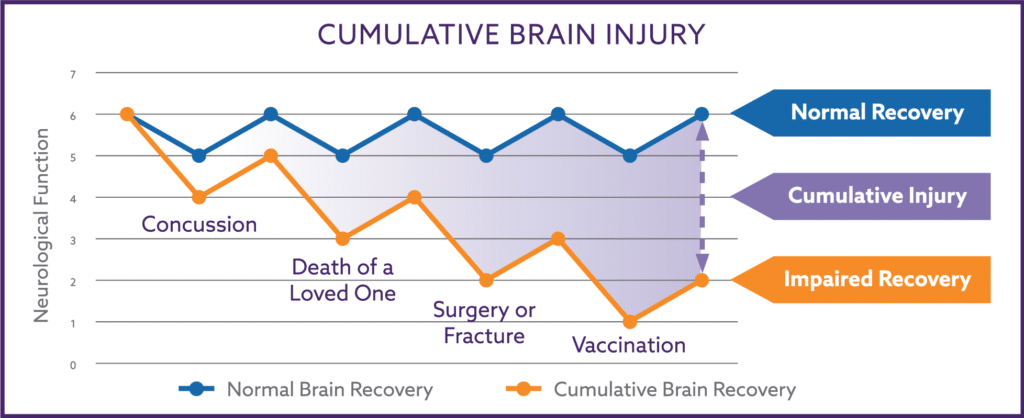
After defining what the autonomics do, Dr. Nemechek discusses how this system can “break.” In this video, he groups causes into three broad categories: physical, emotional, and inflammatory.
1) Physical injury: concussion and related brain injury forces
He describes concussion as a “most common” concept people have for how autonomic problems begin. Using athletes as an example, he lists symptoms often seen after a concussion—such as balance problems, dizziness, and headaches—and says that many of these symptoms are now understood (in the way he’s presenting it) to be due to damage to the autonomic nervous system.
He adds an important qualifier: not every post-concussion symptom is necessarily autonomic. As an example, he mentions depression after concussion and attributes that to damage in a different brain region (the hippocampus), which he says is not part of the autonomic nervous system.
In his interpretation, a key issue in many post-injury symptoms relates to difficulty getting the “right blood pressure up into your head.” He also describes the mechanics of injury as “shearing forces” that can damage brain tissue—something he says can be seen.
2) Emotional injury: “broken heart syndrome” as an example
Dr. Nemechek next discusses emotions as a source of autonomic injury. He gives the example of “broken heart syndrome,” describing a scenario where one spouse dies and the other dies within days. In his explanation, this can involve “massive damage” to the nervous system—particularly the sympathetic branch.
He states that, when researchers try to mimic this kind of event in laboratory animals, the damage from emotions can be visible under a microscope. In this video, he presents this as an example of emotion-driven injury to the autonomics.
3) Inflammatory injury: cytokines, surgery, fractures, and vaccines (as discussed)
He also describes inflammatory damage—framed as the immune system “surging” inflammatory cytokines. In the examples he lists, cytokines can be released from:
- Fractures (especially larger bones such as legs or arms)
- Uncomplicated surgery (including abdominal or chest surgery)
- The overall stress of surgery
In his discussion, these cytokines can damage the brain.
He also mentions vaccines in this context, stating there are animal models showing vaccines can damage the brain. (This article is a transcript-derived summary of what is stated in the video and is not presenting an independent evaluation of that claim.)
A note on terminology: “emotional concussions” and “inflammatory concussions”
To help people conceptualize these categories, Dr. Nemechek says he sometimes uses phrases like physical concussion, emotional concussion, and inflammatory concussion. He notes that these are not standard terms used in neurosciences, but rather language he uses to help patients understand what he means.
Expected recovery timeline and when he suggests additional help
In the video, Dr. Nemechek states that these different types of autonomic damage “should be repaired within a few weeks fully,” assuming everything works as it should. He adds that if recovery does not occur within that time frame, that is when someone would need what he refers to as The Nemechek Protocol™.
Educational medical disclaimer
Want to Learn More About POTS and Autonomic Dysfunction?
Download Dr. Nemechek’s free POTS/PANS/PANDAS eBook for a deeper explanation of autonomic dysfunction, inflammation, and recovery.
This article is for general education only and summarizes statements from a single video by Dr. Patrick Nemechek. It is not medical advice and is not a substitute for individualized evaluation, diagnosis, or treatment by a qualified clinician.