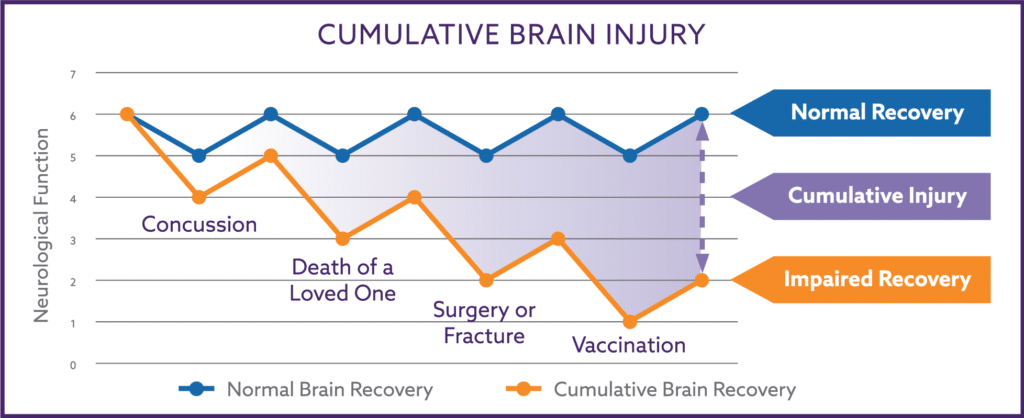
In this clinical review, Dr. Patrick Nemechek discusses a framework for understanding why some people develop problems with focus, fidgeting, headaches, and nicotine use after a concussion or other brain injury. His central point is that the body must constantly regulate blood pressure upward to the head when we are upright, and that this regulation can be disrupted by injury to the autonomic nervous system.
In the video, he links a specific cluster of symptoms—trouble thinking clearly, chronic neck tightness (especially while sitting still), cravings for salt and sugar, and even nicotine use—to the brain’s need to maintain adequate blood flow and oxygen delivery. He also describes why certain substances (including nicotine and common ADHD medications) may temporarily make a person feel better by boosting blood pressure to the brain.
Want to Learn More About POTS and Autonomic Dysfunction?
Download Dr. Nemechek’s free POTS/PANS/PANDAS eBook for a deeper explanation of autonomic dysfunction, inflammation, and recovery.
Educational medical disclaimer: This article summarizes a clinical interpretation presented by Dr. Nemechek in the referenced video and is for education only. It is not medical advice and is not a substitute for personalized evaluation, diagnosis, or treatment from a qualified clinician.
Why blood pressure regulation to the head matters (especially when upright)
Dr. Nemechek begins with a simple but important physical challenge: when a person is upright, the cardiovascular system has to push blood upward against gravity to supply the brain. In his explanation, the body’s ability to maintain appropriate blood pressure to the head is not just a comfort issue—it affects how well the brain is oxygenated.
He emphasizes the brain’s limited “reserve” for oxygen, stating that the brain has about one second of reserve oxygen. In this framework, even brief or repeated drops in effective pressure and flow to the brain can translate into noticeable symptoms—particularly with standing, sitting still, or other situations where the body must actively maintain pressure to the head.
Concussion, the autonomic nervous system, and symptoms that can follow
According to Dr. Nemechek, concussions and other forms of brain injury can damage the autonomic nervous system, which includes the sympathetic and parasympathetic branches. In the model he describes, the sympathetic branch is particularly important for regulating blood pressure to the head.
When that system is impaired, he says people may experience:
- Headaches
- Chronic neck tightness, especially when sitting still
- Difficulty thinking clearly or focusing
- Fidgeting (for example, tapping feet)
- Cravings for salt and sugar
- Nicotine use that can become habitual
He frames these symptoms as a “reflection of the inability to regulate the proper flow and pressure of blood into the brain.” In other words, in his clinical interpretation, the problem is not only “attention” in the psychological sense; it can be a physiologic struggle to keep adequate pressure and oxygen delivery to the brain when upright.
Why lying down can feel different than standing up
Dr. Nemechek contrasts two positions: lying flat versus standing upright. When a person is lying flat, gravity is no longer working against blood flow to the head. In the scenario he describes, even someone with an autonomic injury may have relatively normal blood pressure to the brain while supine.
When standing, however, gravity becomes a challenge again. In his explanation, an injured autonomic nervous system may not be able to generate the needed response to push blood upward as effectively. The result can be lightheadedness or a sense of being “loopy,” alongside the cognitive symptoms described above.
Nicotine, “nicotinic receptors,” and why tobacco may feel relieving in this framework
A key claim in the video is that nicotine can “bypass” damage related to autonomic injury. Dr. Nemechek describes nicotine (from chewing tobacco or smoking) as entering the bloodstream and triggering “nicotinic receptors,” which he describes as part of the sympathetic nervous system. In his explanation, activating these receptors causes two main responses that increase blood pressure to the head:
- The heart beats more vigorously
- Blood vessels “clamp down” (vasoconstrict)
In the context of autonomic injury, he proposes that the normal signaling that would activate these responses becomes disrupted (“broken”), so nicotine may provide a workaround by directly triggering the receptors through the bloodstream. He also notes that salty foods (he gives the example of sunflower seeds) and sweet foods (he mentions Gatorade or bubble gum) can also boost blood pressure to the head in a way that may feel helpful to the brain.
ADHD medications as another “bypass” in Dr. Nemechek’s model
Dr. Nemechek also discusses common ADHD/ADD medications—including Adderall, Concerta, Vyvanse, and Ritalin—through the same physiologic lens. In the model presented, these medications can similarly “bypass” the damaged autonomic signaling and boost blood pressure to the head by acting through the bloodstream on these pathways.
He summarizes this perspective bluntly in the video: he describes ADD/ADHD as symptoms of an inability to regulate blood pressure to the head due to autonomic nervous system damage (for example, after a concussion). This is presented as his clinical interpretation of what the symptoms represent physiologically.
His clinical observation: patterns around smoking frequency and sleep
To illustrate his point, Dr. Nemechek gives a real-world behavioral pattern that he considers supportive of the model: a pack-a-day smoker may feel the need for a cigarette every 30 to 60 minutes during the day and become irritable or agitated without it. Yet, he notes, that same person can often lie down at night and sleep for many hours without smoking.
In his framing, this pattern suggests that the driver is not simply nicotine “addiction” in isolation; rather, he argues it is the brain seeking adequate oxygenation—something that may be easier to maintain when lying flat and harder when upright with impaired autonomic regulation.
Where his program fits: the “Autonomic Advantage” approach
Dr. Nemechek concludes by describing what he calls the “Autonomic Advantage” program. He states that with techniques used in his approach, the average person can, within about three to four months, come off ADD medications or more easily quit nicotine because the program is intended to change the body’s repair mechanism so the body can repair the damage.
This portion of the video is presented as a clinical claim about his program and its intended effects in his practice framework, rather than as a discussion of published evidence or a universal outcome. Anyone considering changes to nicotine use or prescription medication should do so with medical supervision.