Many people associate stroke recovery with regaining movement or speech through rehabilitation. In Dr. Patrick Nemechek’s clinical view, that focus often misses a large part of what patients experience months after a stroke: persistent brain fog, fatigue, anxiety, depression, constipation, reflux, and a general sense that “everything is off.”
In this video, Dr. Nemechek discusses what he sees as a commonly misunderstood and poorly managed phase of care: chronic stroke management. He distinguishes the direct effects of the stroke lesion from what he describes as a secondary, whole-brain inflammatory response that can disrupt function in areas of the brain that were not directly injured.
Educational medical disclaimer: This article summarizes a clinician’s perspective from a video transcript and is for education only. It is not medical advice and is not a substitute for diagnosis or treatment from your licensed clinician. Seek urgent care for new or worsening stroke symptoms.
Motor deficits vs. the “secondary” post-stroke symptom cluster
Dr. Nemechek begins with a typical scenario: an MRI showing a right middle cerebral artery stroke affecting areas involved in motor control. Depending on the precise location, a person may have left arm/leg weakness or paralysis, or left face/arm weakness with speech involvement. Standard care often includes physical therapy, and over 3–6 months some functional recovery may occur—though substantial strokes can leave lasting motor deficits.
What concerns him is the frequency of additional problems that appear after stroke—problems that do not map neatly onto the specific area of cell death seen on imaging. He lists examples he commonly hears from patients and families:
- Brain fog and memory problems
- Persistent fatigue
- Anxiety and/or chronic depression
- Constipation and reflux
- Other systemic complaints that feel unrelated to the stroke location
In his framework, these issues can reflect dysfunction in other brain regions that were not directly infarcted, and therefore may be more reversible than people assume.
Neuroinflammation as a “rippling effect” through the brain
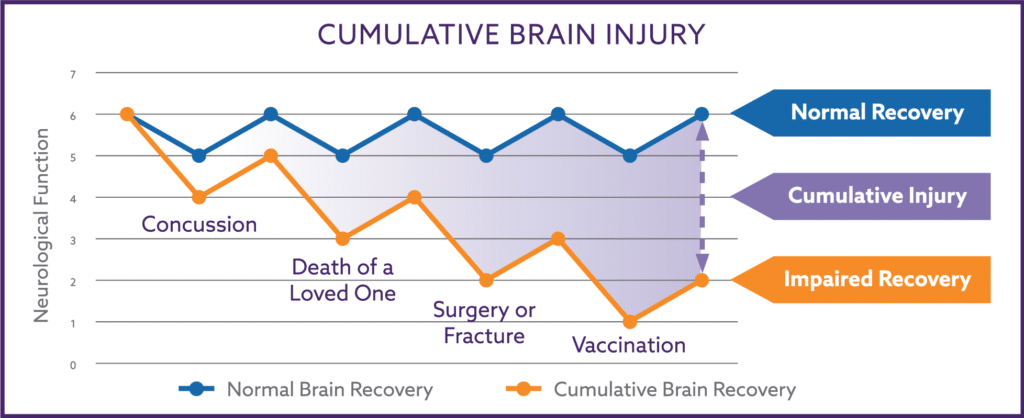
Dr. Nemechek describes stroke as creating a “rippling effect” of inflammation throughout the brain—an inflammatory shock wave. He notes that, as he discusses in other videos, inflammation can damage neurons. He characterizes the result as an “inflammatory concussion” affecting the whole brain, not only the core stroke lesion.
He also makes a broader clinical claim within his framework: people who have had a stroke have “too much inflammation,” and he states that the inflammation is what triggers the stroke in the first place. In his view, if the post-stroke inflammatory burden remains high, patients may not recover well from these secondary effects. He emphasizes that these secondary effects can be “fully reversible” in many patients when the inflammatory process is addressed.
Why the autonomic nervous system may be especially vulnerable
According to Dr. Nemechek, the area most sensitive to this post-stroke inflammatory concussion is the autonomic nervous system (ANS). He characterizes the ANS as a regulating system that helps the body coordinate responses to stress. In his description, it influences:
- Emotions
- Hormones
- Immune function
- Metabolism
- Blood pressure and heart rate
- Intestinal motility and bladder function
He draws an analogy to sports-related concussions, noting that many classic concussion complaints can arise from this regulatory part of the brain. In his view, a similar symptom pattern can occur after an inflammatory-type injury following stroke.
Two common downstream problems he sees after stroke
1) Trouble generating adequate blood pressure into the brain (cerebral hypoperfusion)
Dr. Nemechek says many post-stroke complaints can be broken down into two “mechanical” issues. The first is difficulty generating blood pressure into the head at the proper pressure. He emphasizes that this is not usually about oxygenation in the lungs; rather, it is about pushing oxygenated blood into the brain at the right pressure.
He states that neurons have very limited spare oxygen (“one second of spare oxygen”), so inadequate cerebral perfusion can contribute to:
- Poor concentration and difficulty thinking
- Fatigue
- Anxiety or fidgetiness
- Cravings for salt and sugar
He uses the clinical term cerebral hypoperfusion and connects it to post-stroke cognitive problems. He also makes an interpretive comparison: when this low-pressure/low-perfusion pattern occurs in younger people (not necessarily after stroke), it may be labeled as attention deficit disorder. In his view, many stroke patients may effectively have an undiagnosed attention-deficit-like syndrome due to this reversible autonomic-related injury.
2) Slowed intestinal motility: constipation, SIBO, and “leaky gut”
The second major issue he highlights is slowed intestinal transit. He describes the intestinal tract like a conveyor belt, where each segment needs to push contents forward. After stroke, he frequently sees constipation, and he cites an estimated risk around 60% in acute or subacute stroke.
He links this bowel slowing to secondary autonomic disruption rather than the local stroke lesion itself. He then describes a cascade: when motility slows, bacteria from the colon can populate the small intestine—what he calls SIBO. He states that this can lead to “leaky gut,” which then increases inflammation and worsens stroke outcomes.
Dr. Nemechek’s clinical framework for recovery
Dr. Nemechek explains that the Nemechek Protocol was designed to reverse autonomic nervous system damage, based on work he describes as spanning nearly 25 years, with a patent obtained about 12 years ago. In the transcript, he describes the protocol components as:
- Fish oil
- Olive oil
- Vagus nerve stimulation in the ear
- A non-absorbable antibiotic he calls “refaim”/rifaximin (described as very safe and used for decades)
He reports that in his stroke patients, non-motor post-stroke issues often improve substantially, with many patients describing themselves as normal or near normal in those domains. He contrasts these secondary symptoms with motor deficits, stating that the motor injury from the stroke is separate from the mechanisms he is addressing when treating brain fog, constipation, and emotional lability.
Time course and next steps he recommends
In the video, Dr. Nemechek says that, in his experience, patients may see “dramatic improvement” over roughly 6–8 months on his protocol. For those looking for implementation details, he advises obtaining one of his books and using the adult dosing guidance presented there (he references the book sections discussing attention deficit disorder as the place where adult doses are listed). He also notes that the non-absorbable antibiotic is discussed in the book, and suggests working with a local physician if possible, or scheduling a visit with his practice if needed.
His overarching message is that there may be “a lot to be gained” after stroke by focusing on reducing inflammation in a targeted way, allowing the nervous system—especially areas outside the core stroke lesion—to recover.