Many people can point to a single “big event” that changed their health—an accident, a major illness, or a severe concussion. But in Dr. Patrick Nemechek’s clinical framing, a large neurologic hit isn’t the only pathway to lingering symptoms.
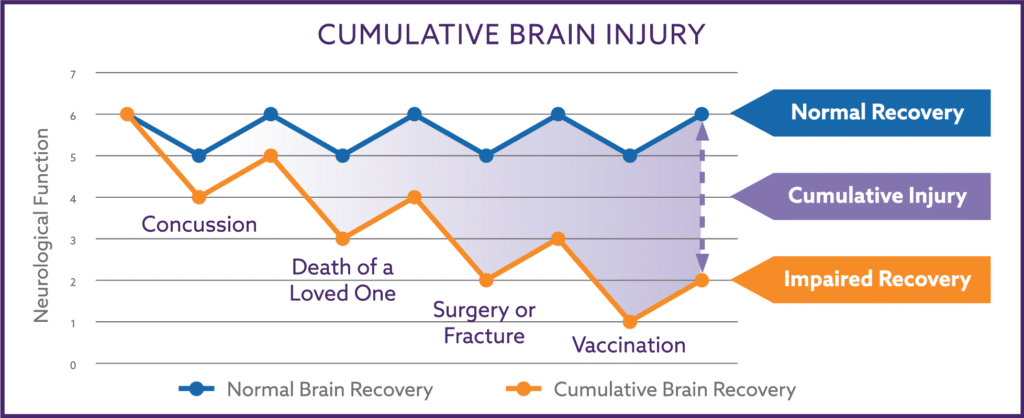
In this video, he explains a phenomenon he calls cumulative brain injury, which he notes is increasingly referred to in the literature as repetitive mild traumatic brain injury. The core idea: what seem like small, “inconsequential” injuries or stressors may add together over time until their combined effect resembles a single major injury.
He emphasizes that people often don’t report these minor events to their physician because they don’t seem medically important in the moment—yet the accumulation may help explain long-standing, progressive symptoms such as autonomic dysfunction.
How neurons can be damaged: Dr. Nemechek’s categories of injury
Dr. Nemechek describes several ways that neurons can be injured. Some are familiar (like blunt head trauma), while others involve emotional stress, inflammation, or chemical triggers. In his description, the unifying theme is that these different inputs can still result in neuronal injury that may be visible microscopically, even when standard imaging is unrevealing.
1) Physical injury: concussion and sub-concussive impacts
He begins with classic physical head injury. In his explanation, a concussion involves neuronal damage without bleeding in the brain—so tests like MRI or CT can be normal—yet symptoms may persist for days or longer.
He also highlights sub-concussive injuries: impacts that may damage neurons without obvious lasting symptoms. As an example, he mentions heading a soccer ball, and notes this is one reason certain youth leagues restrict heading.
2) Emotional trauma
Dr. Nemechek states that emotional trauma can cause neuronal damage that can be seen under a microscope. He contrasts severe emotional events—such as Takotsubo syndrome (which he refers to as “dying of a broken heart”)—with smaller, everyday stressors. In his analogy, these smaller stressors can be like “emotional soccer balls,” such as the distress of a pet going missing briefly.
3) Inflammation-related injury
He then discusses inflammation. He describes how large orthopedic injuries (such as fractures of major bones) can lead to release of inflammatory chemicals. In his framework, similar inflammatory signaling may be associated with brain injury that can be seen microscopically.
He also states that even the physical stress of an uncomplicated surgical incision (for example, abdominal or thoracic surgery) can be associated with brain injury observable under a microscope.
4) Vaccine stimulation (as described in the video)
Dr. Nemechek also states that stimulation of a vaccine has the potential to be associated with brain injury visible in the microscope. He presents this as part of a broader discussion of inflammatory or immune stimulation and its possible neurologic effects in his framework.
5) Chemical injury: bacterial overgrowth and propionic acid (as described in the video)
He mentions the possibility of chemical injuries in autism, describing a scenario involving bacterial overgrowth and production of propionic acid. He notes there is data in animal models suggesting propionic acid may cause a brain injury.
6) A pregnancy-related pattern he observes clinically
Finally, he describes a phenomenon he says he has observed in some pregnancies—often around the second or third pregnancy—where a woman develops sustained autonomic dysfunction “like they’ve been in a serious car wreck.” He adds that his clinic can help patients recover, but he does not know how to categorize the cause (metabolic vs physical) and explicitly states he does not know exactly what it is.
Why “small” events may start to matter: incomplete recovery in chronic inflammatory stress
Dr. Nemechek explains that decades ago (he references the 1960s), people were generally expected to fully recover from many of these insults—an idea passed down through family experience and medical teaching. In his interpretation, what has changed is the burden of chronic inflammatory stress, which he says can prevent full recovery even from smaller injuries.
In the scenario he outlines: someone gets a concussion, symptoms improve, and they feel “better,” but they may not return to their true baseline. He describes this as leaving behind a small amount of residual damage. Then additional stressors occur—another head bump (for example, hitting the car hatch), a short-lived but intense conflict or scare at work, an immunization, and other life events. In his framing, the residual damage “builds, builds, builds.”
That accumulation, he argues, can reach a level comparable to the brain injury of a severe event—such as being thrown from a car—despite no single dramatic incident.
How this may show up clinically: long-term autonomic dysfunction
Dr. Nemechek describes seeing this pattern commonly in adult patients who report progressive symptoms over 20–30 years and wonder where the “brain injury” is, because they can’t identify one defining event.
He specifically links cumulative injury to autonomic dysfunction symptoms and provides examples such as low blood pressure with lightheadedness, headaches, anxiety, and gastrointestinal symptoms. He also mentions sweating problems (too little or too much), bladder dysfunction, and other autonomic symptoms.
Why he considers it a “big deal”
In the video, Dr. Nemechek emphasizes that repetitive mild traumatic brain injury is important and points to recent work he finds “very interesting,” suggesting this area may be relevant to conditions such as Alzheimer’s and Parkinson’s as research progresses. He presents this as an emerging direction rather than a settled conclusion.
What he recommends focusing on (as stated in the video)
To close, Dr. Nemechek encourages viewers to keep working on inflammation and mentions specific areas of focus in his approach: fish oil, olive oil, “balance your gut,” and vagal stimulation.
Educational disclaimer: This article summarizes statements and perspectives from Dr. Patrick Nemechek’s video and is for general education only. It is not medical advice and is not a substitute for personalized evaluation, diagnosis, or treatment from a licensed clinician.