Publication date: February 17, 2026
In this video, Dr. Patrick Nemechek reviews a recent paper on what the authors describe as “cumulative brain injury” after multiple concussions (often categorized in research as mild traumatic brain injuries). He uses the study as a springboard to explain a pattern he says he has seen for years in clinical practice: when injuries happen repeatedly—especially in the context of chronic inflammation—patients may not fully return to baseline after each event, and symptoms can slowly accumulate.
He also broadens the discussion beyond purely physical head impacts. In his framework, “concussion-like” brain effects can occur after emotional trauma and after inflammatory triggers, and these can add to the total burden even when a person is only “counting” physical concussions.
What Dr. Nemechek means by “concussion” (and the main types he describes)
Dr. Nemechek defines a concussion as neuronal damage that is not severe enough to cause bleeding—so imaging such as an MRI can appear normal even when a person is symptomatic.
He describes three basic forms:
- Direct impact (for example, being hit in the head by an object)
- Acceleration/deceleration (for example, a rear-end collision with “whiplash,” where the brain moves back and forth in the skull)
- Blast concussion (an area of increasing attention, including repeated blast exposure in military contexts; he notes even a gun going off nearby could be relevant)
The paper he reviewed: multiple concussions vs one vs none
The paper Dr. Nemechek discusses compared people who had experienced multiple concussions with those who had one concussion and those with none. He notes the sample was large (he cites 1,710 patients).
In his summary of the findings, individuals with multiple concussions had significantly worse scores in areas including:
- Cognition
- How they felt overall
- Emotionality (as he describes it)
He also states the group with multiple concussions had a much greater risk of post-traumatic stress disorder (PTSD), which he explains can be tied to the emotionally threatening events that sometimes accompany concussions (examples he lists include war, a serious car wreck, or assault). In his retelling, the study suggested that the more injuries a person had, the worse the associated PTSD.
His clinical framework: “cumulative brain injury” and the role of chronic inflammation
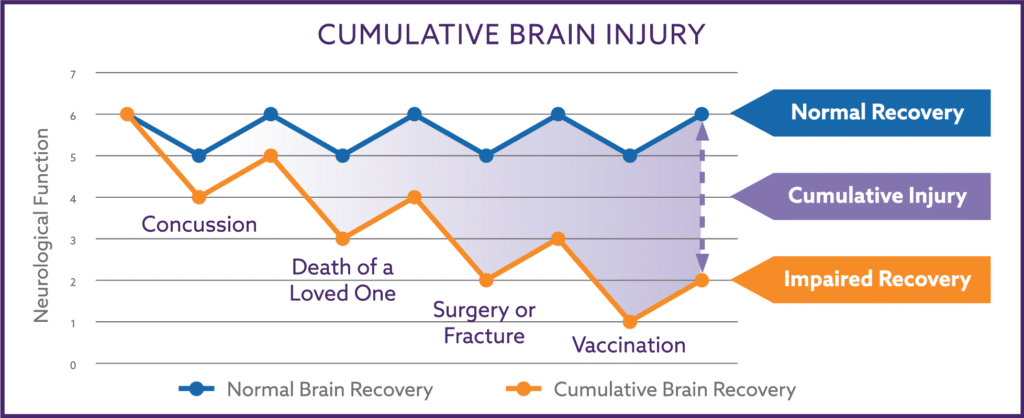
Dr. Nemechek says these findings align with a long-observed pattern in his practice, which he refers to with patients as cumulative brain injury. He also notes there is animal data supporting the idea, and that this was the first human data he had seen that reflected it in the way he describes.
In the framework discussed in the video, the difference between fully recovering after an injury versus accumulating injury over time depends heavily on baseline inflammation:
- When inflammation is low: a person has an injury, functioning drops, and then the person returns to baseline—repeating this pattern with subsequent injuries.
- When chronic inflammation is present: Dr. Nemechek explains the injury can be “magnified,” recovery may be incomplete, and a person may feel better without actually returning to their prior baseline. Over repeated injuries, the incomplete recovery can stack, with damage “building up” over time.
He emphasizes a practical problem he sees frequently: people may not realize they never fully recovered, and they may not be counting the full range of injuries that can contribute to the cumulative pattern he describes.
Not just physical concussions: emotional and inflammatory “concussion-like” injuries (as described in the video)
Dr. Nemechek states that, in addition to physical concussions, people can experience brain injuries that are “like concussions” that are not physical. Specifically, he says:
- Emotional trauma can cause a brain injury.
- Inflammation-driven injuries can produce a concussion-like effect; he lists triggers including surgeries, fractures of large bones, a COVID infection, and notes that some vaccines can as well.
In his interpretation, these emotional and inflammatory injuries may be happening alongside physical concussions, and if a person has chronic inflammation, the same pattern of partial recovery and cumulative buildup can occur.
How cumulative injury may present: autonomic dysfunction and symptom patterns he sees
According to Dr. Nemechek, the cumulative damage pattern he describes commonly results in autonomic dysfunction. He highlights several symptom clusters he associates with this presentation:
GI motility slows down
He says intestinal motility can slow, leading to symptoms such as:
- Reflux/heartburn
- IBS
- Constipation
Low blood pressure in the brain and cognitive/emotional effects
Dr. Nemechek describes what he considers one of the most disabling effects: low blood pressure in the brain, which he explains interferes with oxygenating the brain “correctly.” In the video, he connects this to symptoms including:
- Brain fog and cognitive problems
- Anxiety and aggression
- Increased appetite (being hungry more)
- Impaired sleep
Head and neck pain
He adds that the low-pressure effect can also affect the scalp muscles, contributing to headaches, and may also contribute to neck pain, including what he calls “codangar pain.”
His takeaway: lowering inflammation and the goal of autonomic recovery
Dr. Nemechek emphasizes that, in his clinical interpretation, there is good news: if inflammation can be lowered, the autonomic nervous system can recover. He states that this is what the Nemechek Protocol was designed to do—lower inflammation—and that in their in-office research they have observed that people can fully recover and that the autonomic nervous system can recover.
Educational medical disclaimer
Want to Learn More About POTS and Autonomic Dysfunction?
Download Dr. Nemechek’s free POTS/PANS/PANDAS eBook for a deeper explanation of autonomic dysfunction, inflammation, and recovery.
This article summarizes a single video in which Dr. Patrick Nemechek reviews one paper and shares his clinical framework and observations. It is for general education only and is not medical advice. If you have ongoing symptoms after concussion, emotional trauma, or illness—or concerns about autonomic dysfunction, PTSD, or cognitive changes—seek evaluation from a qualified clinician for individualized diagnosis and care.