In this video, Dr. Patrick Nemechek continues a short series aimed at helping families interpret progress on the Nemechek Protocol—especially when improvement is visible, but not complete. His focus here is not on the situation where a child is not getting better, but rather when “everything’s not getting better” even though many areas are clearly improving.
He describes a common pattern: teachers, therapists, and relatives may notice substantial changes, yet a parent still sees one or two areas that seem “stuck.” Examples he mentions include constipation not improving at all, persistent hyperactivity, or socialization remaining flat despite other gains (such as speech) moving forward.
Educational medical disclaimer: This article summarizes one clinician’s discussion and framework from a video and is not medical advice. Decisions about devices or treatment should be made with a qualified clinician who can evaluate your child’s individual situation.
First principle in this series: gut balance as the foundation
Dr. Nemechek frames the earlier videos in this series around what he calls the “primary importance” of getting the intestinal tract balanced. In his words, “It’s really about the gut… It’s all about the gut.” In the context of families who are disappointed by limited change, he emphasizes looking at whether the gut work is actually holding: for example, whether inulin “quit working” or “never worked,” or whether there are relapses around rifaximin.
In this fourth video, he contrasts that earlier problem set with a different scenario: when you do get the gut balanced along with fish oil and olive oil, a child may experience “a lot of recovery,” and outside observers notice meaningful changes. Yet even with those broad improvements, one symptom cluster may lag behind.
Why “finessing oils” isn’t his answer to a plateau
Within his discussion, Dr. Nemechek cautions families against repeatedly tweaking fish oil and olive oil—switching brands or types—in hopes of unlocking that last area of recovery. He states that “finessing it, this oil or that olive oil… ain’t gonna make a difference,” and reiterates that he views the bigger issue as whether the intestinal tract is truly balanced.
He also encourages patience about tempo. In his clinical interpretation, “you can’t speed it up,” saying the body has “one speed.” The key, in his framing, is whether overall recovery is “marching forward” even if it is slower than families want.
When one area is truly “stuck” despite overall improvement
The specific plateau he highlights is when an area is “completely not progressive” while other areas of neurological recovery continue to improve. He uses socialization as a leading example: if it is not moving forward at all while other gains are apparent, he considers that a different category than “slow progress.”
In his framework, this is the point at which he may consider adding vagal neuromodulation—not as a universal next step, but as a targeted tool for those last languishing domains.
Dr. Nemechek’s description of vagal neuromodulators
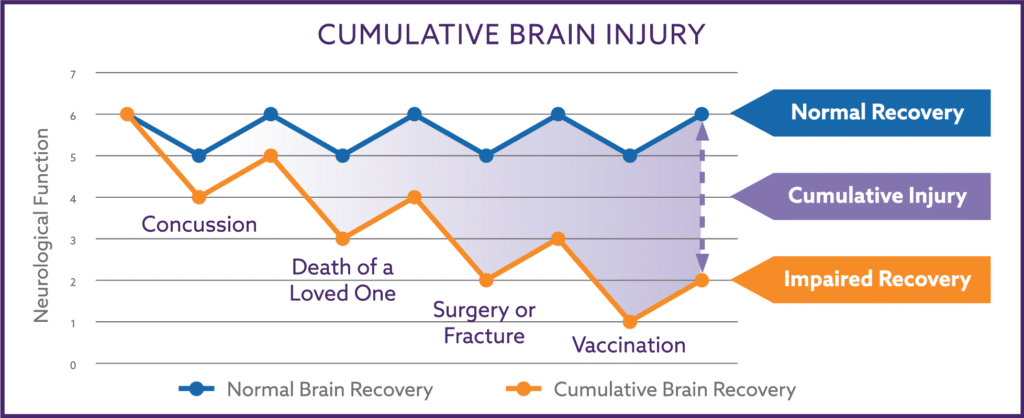
Dr. Nemechek describes vagal neuromodulators as devices that attach to the ear. In this video, he characterizes them as tools that “help control inflammation” and “help control microglial function.” He also describes what he calls a “phenotypic shift,” explaining that the devices can trigger “M1 Primed Microglia” (which he describes as harmful and as not pruning, leading to cumulative brain injury) to shift toward a healthier mode he calls “M2 microglia.”
In the framework discussed in the video, when that shift occurs, the “last areas that are kind of languishing” may begin to improve as well.
Who may (and may not) need a neuromodulator in his approach
Dr. Nemechek is explicit that he does not believe most children need these devices, stating, “More is not necessarily better.” Instead, he suggests a time-and-pattern checkpoint: after “a good 4–6 months of observed improvement,” if one specific issue is “really… stuck” and not improving like the other aspects of recovery, that is when he considers a neuromodulator.
He also notes access limitations for the devices his office dispenses: in his practice, they are available only after a face-to-face visit so he can determine whether it is the correct step. At the same time, he mentions that other devices are coming to market that may do the same thing, potentially helping families who cannot travel.
Staying disciplined: avoid adding “other supplements” to chase the last symptom
A central caution in his closing message is not to layer on additional supplements in an attempt to fix a specific lingering problem. He states, “don’t add other supplements to try to fix this little problem… Nobody knows how to do that.”
Instead, he summarizes the intent of the Nemechek Protocol in his own terms: “All that The Nemechek Protocol is doing is lowering inflammation, controlling these primed microglia, and when you do that, the brain will fix itself.” He adds that he often sees families add something that “gets in the way,” or they experience relapse.
Takeaway: plateaus may be about time—or about a targeted next step
In Dr. Nemechek’s view, slow overall improvement is not necessarily a problem to “hack” or accelerate; he emphasizes patience and consistency (“don’t miss a dose”). But when one key domain remains non-progressive after months of broad improvement, he describes vagal neuromodulation as a potential next step within his clinical framework—used selectively, not routinely.