Postural Orthostatic Tachycardia Syndrome, or POTS, is finally becoming more widely recognized, yet many patients still arrive in my office after months or years of being told that their symptoms are anxiety, deconditioning, or simply something they need to learn to live with.
POTS is real. More importantly, I believe it is often possible to substantially improve the underlying autonomic dysfunction rather than simply manage the elevated heart rate.
In the accompanying video, “Mechanisms of Autonomic Stability: Understanding POTS and the Path to Recovery,” I discuss a different way of thinking about POTS—one that focuses not only on heart rate, but on the brain, blood flow, inflammation, and the autonomic nervous system’s ability to repair itself.
POTS Is an Autonomic Problem
The autonomic nervous system continuously regulates functions that we rarely think about: blood pressure, heart rate, digestion, temperature regulation, hormone responses, immune activity, and the distribution of blood throughout the body.
When we stand, gravity suddenly pulls a substantial amount of blood downward. A healthy autonomic nervous system detects this change and rapidly adjusts vascular tone and heart rate so that adequate blood continues reaching the brain.
In POTS, this regulatory system is not working normally.
The most obvious sign is the excessive rise in heart rate when standing. But focusing exclusively on heart rate can miss what I believe is a more important issue: the body is struggling to maintain adequate blood flow to the brain.
Reduced cerebral perfusion can contribute to the cluster of symptoms commonly reported by people with autonomic dysfunction—fatigue, brain fog, headaches, difficulty concentrating, exercise intolerance, lightheadedness, anxiety-like sensations, and an overwhelming need to sit or lie down.
The racing heart is often a compensatory response. The heart is trying to preserve circulation when the autonomic system is not regulating vascular tone appropriately.
What Injures the Autonomic Nervous System?
People frequently associate neurological injury with a dramatic concussion or accident. But injury to neural function can occur in several different ways.
Physical trauma is one mechanism. This can include a significant concussion or the accumulation of smaller repetitive injuries.
Severe emotional or physiological stress may also alter neurological and autonomic function. Extreme stress is capable of producing very real physiological consequences; Takotsubo cardiomyopathy—sometimes called “broken-heart syndrome”—is a striking example of how intense stress can temporarily disrupt cardiovascular function.
A third important pathway is immune activation.
Infections and other inflammatory events produce large surges of immune signaling molecules. COVID-19 made this relationship particularly visible because a subset of patients developed persistent autonomic symptoms following infection. POTS and other forms of dysautonomia are now well recognized among the manifestations that can occur after COVID.
The important question, however, is not simply what started the problem.
It is: Why doesn’t the nervous system fully recover afterward?
Persistent Inflammation May Interfere With Recovery
The human nervous system has much greater repair capacity than we once appreciated. The brain can modify connections, reorganize networks, alter signaling pathways, and engage biological repair processes long after an initial injury.
Yet those processes operate within a biological environment.
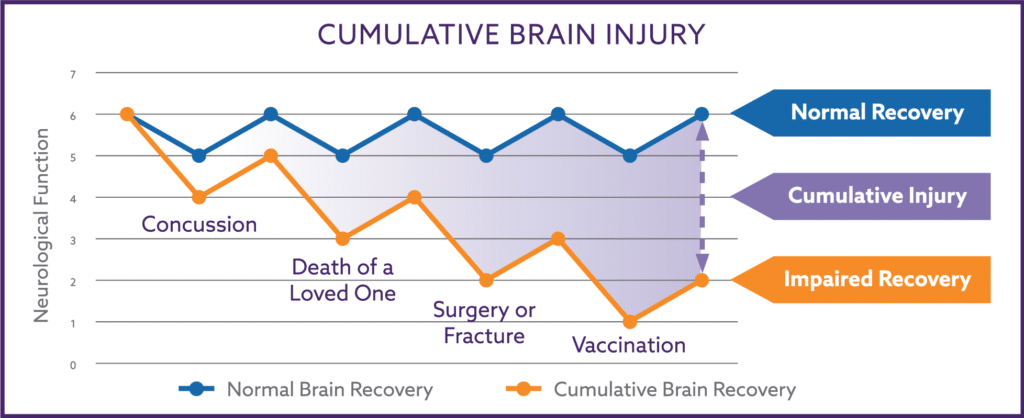
My clinical work over the past two decades has increasingly focused on the possibility that persistent systemic inflammation interferes with neurological recovery. Instead of inflammation turning on briefly in response to an infection or injury and then shutting down, some individuals appear to remain in a state of chronic inflammatory activation.
In that environment, a person may recover incompletely from one insult and then experience another—an infection, surgery, injury, severe stress, or other inflammatory event. Over time, the effects can accumulate.
This provides a different way of viewing patients whose health seems to deteriorate progressively despite there being no single catastrophic neurological event.
My Treatment Framework
This is why my approach to POTS is not centered solely on suppressing the heart rate.
Medications, fluids, salt, compression garments, and other conventional measures can be valuable for controlling symptoms and maintaining function. In some patients I also use medications that help support blood pressure and cerebral perfusion.
But my broader objective is to create an environment in which autonomic recovery can occur.
The Nemechek Protocol focuses heavily on reducing sources of persistent inflammation. Depending upon the individual patient, this may include specific dietary changes, high-DHA omega-3 fatty acids, extra-virgin olive oil, management of intestinal bacterial overgrowth when clinically appropriate, and noninvasive vagus nerve stimulation.
The reasoning is straightforward: rather than attempting to somehow force the brain to repair itself, reduce the biological factors that may be interfering with its own repair mechanisms.
Vagus nerve stimulation is particularly interesting because the vagus nerve participates in autonomic regulation as well as pathways involved in controlling inflammatory signaling. It has therefore become an important part of my treatment strategy for many adults with significant autonomic dysfunction.
Recovery Is the Goal
Perhaps the most important message for someone living with POTS is that the diagnosis should not automatically be interpreted as a permanent loss of function.
Recovery is rarely instantaneous. Autonomic systems often improve gradually over months, and progress may occur unevenly. But I have seen patients improve substantially even after being symptomatic for many years.
That experience has changed the question I ask.
Rather than simply asking, “How do we control the tachycardia?”
I think we should also be asking:
“What is preventing this autonomic nervous system from recovering?”
That shift—from managing a heart-rate abnormality to understanding the biology of autonomic recovery—is the central idea I discuss in the video.
If you have POTS, orthostatic intolerance, persistent symptoms following COVID, or unexplained autonomic dysfunction, I encourage you to watch the full discussion.
— Patrick M. Nemechek, DO
This article is intended for educational purposes and does not substitute for individualized medical evaluation or treatment.